A New Era in Sports Injury Recovery
Athletes are increasingly choosing biologic therapies because they harness the body’s own healing cells, reducing downtime and avoiding surgery risks. Regenerative medicine rests on three core principles: autologous biologic products, such as PRP and BMAC, deliver concentrated growth factors and stem cells; minimally invasive, ultrasound‑guided delivery targets the injury; and modulation of inflammation promotes tissue remodeling. Dr. Jaimal Sangha’s practice embodies a patient‑centered philosophy, customizing treatment plans, integrating rehabilitation, and emphasizing natural recovery pathways to accelerate safe return to sport.
Regenerative Medicine Foundations and Legitimacy
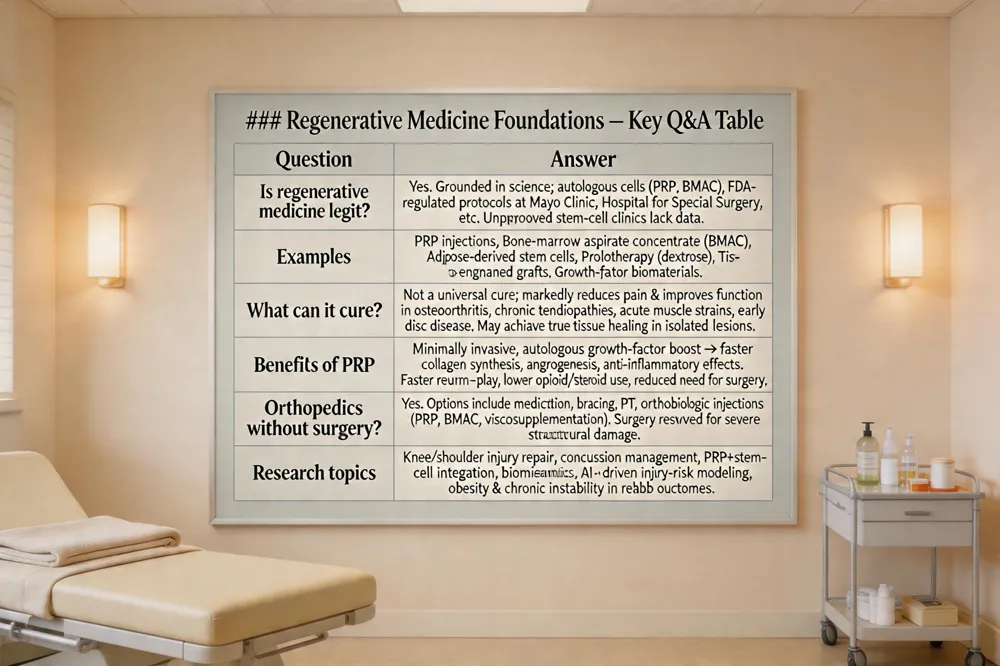
Regenerative Medicine Foundations – Key Q&A Table
| Question | Answer |
|---|---|
| Is regenerative medicine legit? | Yes. Grounded in science; uses autologous cells (PRP, BMAC). FDA‑regulated protocols at Mayo Clinic, Hospital for Special Surgery, etc. Unapproved stem‑cell clinics lack data. |
| Examples | PRP injections, Bone‑marrow aspirate concentrate (BMAC), Adipose‑derived stem cells, Prolotherapy (dextrose), Tissue‑engineered grafts, Growth‑factor biomaterials. |
| What can it cure? | Not a universal cure; markedly reduces pain & improves function in osteoarthritis, chronic tendinopathies, acute muscle strains, early disc disease. May achieve true tissue healing in isolated lesions. |
| Benefits of PRP | Minimally invasive, autologous growth‑factor boost → faster collagen synthesis, angiogenesis, anti‑inflammatory effects. Faster return‑to‑play, lower opioid/steroid use, reduced need for surgery. |
| Orthopedics without surgery? | Yes. Options include medication, bracing, PT, orthobiologic injections (PRP, BMAC, viscosupplementation). Surgery reserved for severe structural damage. |
| Research topics | Knee/shoulder injury repair, concussion management, PRP + stem‑cell integration, biomechanics, AI‑driven injury‑risk modeling, obesity & chronic instability in rehab outcomes. |
 Is regenerative medicine legit?
Regenerative medicine is a scientifically grounded discipline that leverages autologous cells—such as platelet‑rich plasma (PRP) and bone‑marrow‑derived concentrate—to stimulate tissue repair and modulate inflammation. Leading academic centers (Mayo Clinic, Hospital for Special Surgery) employ FDA‑regulated protocols and peer‑reviewed research, confirming safety when performed by qualified clinicians. Caution is warranted for unapproved “stem‑cell” clinics that lack rigorous data.
Is regenerative medicine legit?
Regenerative medicine is a scientifically grounded discipline that leverages autologous cells—such as platelet‑rich plasma (PRP) and bone‑marrow‑derived concentrate—to stimulate tissue repair and modulate inflammation. Leading academic centers (Mayo Clinic, Hospital for Special Surgery) employ FDA‑regulated protocols and peer‑reviewed research, confirming safety when performed by qualified clinicians. Caution is warranted for unapproved “stem‑cell” clinics that lack rigorous data.
Regenerative medicine examples
- PRP injections: concentrated platelets delivering PDGF, TGF‑β, VEGF for tendons, ligaments, cartilage.
- Bone‑marrow aspirate concentrate (BMAC): mesenchymal stem cells, growth factors for cartilage, bone, tendon regeneration.
- Adipose‑derived stem cells and prolotherapy (dextrose) to trigger controlled inflammation and healing.
- Tissue‑engineered grafts and growth‑factor biomaterials for complex repairs.
What can regenerative medicine cure? It is not a universal cure but can markedly reduce pain and improve function in osteoarthritis, chronic tendinopathies, acute muscle strains, and early‑stage disc disease. PRP and BMAC may achieve true tissue healing in isolated lesions, though many conditions still require repeat injections and adjunct rehab.
What are the benefits of platelet‑rich plasma? PRP provides a minimally invasive, autologous boost of growth factors that accelerates collagen synthesis, angiogenesis, and anti‑inflammatory pathways. Patients often experience faster return‑to‑play, lower reliance on opioids or steroids, and a reduced need for surgical intervention.
Can you go into orthopedics without surgery? Yes. Non‑surgical orthopedic care includes medication, bracing, physical therapy, and orthobiologic injections (PRP, BMAC, viscosupplementation). These approaches aim to restore function while avoiding the risks and downtime of surgery, reserving operative treatment for severe structural damage.
Sports medicine research topics Current investigations focus on knee and shoulder injury repair, concussion management, and the integration of PRP and stem‑cell therapies to speed recovery. Emerging work explores biomechanics, AI‑driven injury‑risk modeling, and the role of obesity and chronic instability in rehabilitation outcomes.
Platelet‑Rich Plasma: How It Works, Benefits, and Costs
Platelet‑Rich Plasma (PRP) – Quick‑Reference Table
| Aspect | Details |
|---|---|
| Mechanism | Autologous blood draw → centrifuge → 3‑10× platelet concentration → growth factors (PDGF, TGF‑β, VEGF) stimulate fibroblast proliferation, collagen synthesis, angiogenesis, anti‑inflammatory cytokines. |
| Clinical Benefits | Tendons/Joints: ↓ pain, ↑ function in lateral epicondylitis, patellar tendinopathy, Achilles tendinitis, rotator‑cuff tears, early OA; athletes return 20‑40 % faster. <br>Skin/Facial: Boost collagen & elastin when combined with microneedling → smoother texture, reduced fine lines (2‑6 mo). <br>Hair: Prolongs anagen phase, ↑ follicular density & shaft thickness; 70‑80 % see regrowth after 3‑4 monthly sessions. |
| Cost (USD) | General injection: $500‑$2,500 (typical $600‑$1,200). <br>Knee PRP: $800‑$1,000 per injection (often $500 for single treatment). <br>Facial PRP: $900‑$1,100 per area. <br>Hair PRP: $1,500‑$3,500 for 3‑4 initial sessions; maintenance $500‑$800. |
| Return‑to‑Play | 2‑month reassessment for most injuries; PRP can shave 20‑40 % off standard rehab timeline. |
| Insurance | Generally not covered; cash‑based discounts, HSA/FSA, multi‑session packages common. |
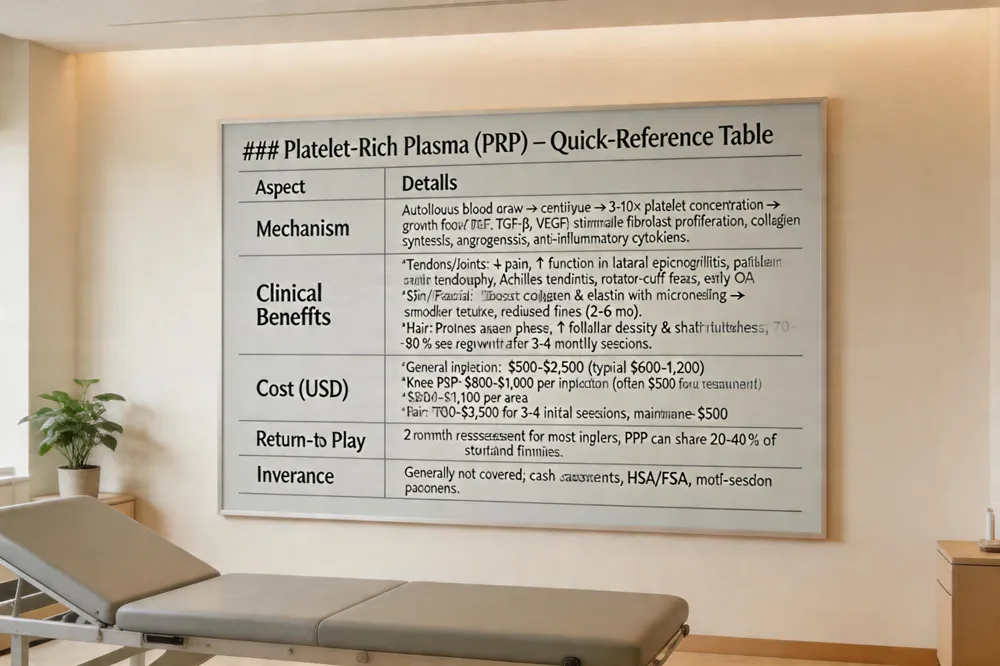 Platelet‑Rich Plasma (PRP) therapy begins with a small draw of the patient’s own blood, which is then centrifuged to concentrate platelets 3‑10 × baseline. The resulting plasma is rich in growth factors such as PDGF, TGF‑β, and VEGF that stimulate fibroblast proliferation, collagen synthesis, angiogenesis, and anti‑inflammatory cytokine modulation. Ultrasound‑guided injection places the biologic directly into tendons, ligaments, joints, skin, or scalp, leveraging the body’s natural healing cascade.
Clinical benefits
- Tendons and joints: PRP reduces pain and improves function in lateral epicondylitis, patellar tendinopathy, Achilles tendinitis, rotator‑cuff tears, and early osteoarthritis, often allowing athletes to return to sport 20‑40 % faster than standard rehab.
- Skin and facial rejuvenation: When combined with microneedling, PRP delivers growth factors that boost collagen and elastin, resulting in smoother texture, reduced fine lines, and a plumper appearance within 2‑6 months of treatment. Side effects are limited to mild bruising and transient swelling.
- Hair restoration: Autologous PRP injected into the scalp prolongs the anagen phase, increases follicular density, and thickens shafts. Studies report 70‑80 % of patients see measurable regrowth after three to four monthly sessions, with a typical 30‑40 % increase in hair count.
Cost considerations
- General PRP injection: $500‑$2,500 per session; most clinics price $600‑$1,200. Insurance usually does not cover it, though cash‑based discounts, HSA/FSA payments, and multi‑session packages are common.
- Knee PRP: $800‑$1,000 per injection (often $500 for a single treatment). Flexible financing and bundled pricing are offered by many practices, including Dr. Jaimal Sangha’s team.
- Facial PRP: Performed in an office setting, the procedure costs $900‑$1,100 for one area; multiple‑area treatments increase the total.
- Hair PRP: A series of three to four initial injections ranges $1,500‑$3,500, with maintenance visits $500‑$800.
Overall, PRP offers a minimally invasive , patient‑centered alternative that accelerates tissue repair, reduces reliance on steroids or opioids, and aligns with conservative sports‑medicine philosophies.
Stem‑Cell and Bone Marrow Aspirate Therapies for Athletic Injuries
Stem‑Cell & BMAC Therapies – Summary Table
| Therapy | Source | Indications | Typical Cost (USD) | Safety / Regulatory |
|---|---|---|---|---|
| Bone‑Marrow Aspirate Concentrate (BMAC) | Autologous iliac‑crest aspirate (platelets, WBCs, MSCs) | Knee cartilage lesions, rotator‑cuff repairs, chronic tendinopathies | $1,200‑$3,500 per procedure (varies by clinic) | Autologous → low immune risk; FDA classifies minimally manipulated cells as low‑risk biologic. |
| Adipose‑Derived Stem Cells | Autologous fat harvest (lipo‑aspirate) | Musculoskeletal injuries, joint degeneration, soft‑tissue repair | $2,000‑$5,000 per session (often investigational) | Mostly investigational; not FDA‑approved for many indications. |
| Peripheral‑Blood MSCs | Autologous blood draw + ex‑vivo concentration | Early‑stage cartilage, tendon healing | $1,500‑$3,000 | Similar regulatory status to BMAC; limited long‑term data. |
| Safety Profile | — | — | — | Autologous products minimize disease transmission; most adverse events are transient soreness or bruising. |
| Insurance | — | — | — | Generally not covered; patients pay out‑of‑pocket or use financing. |
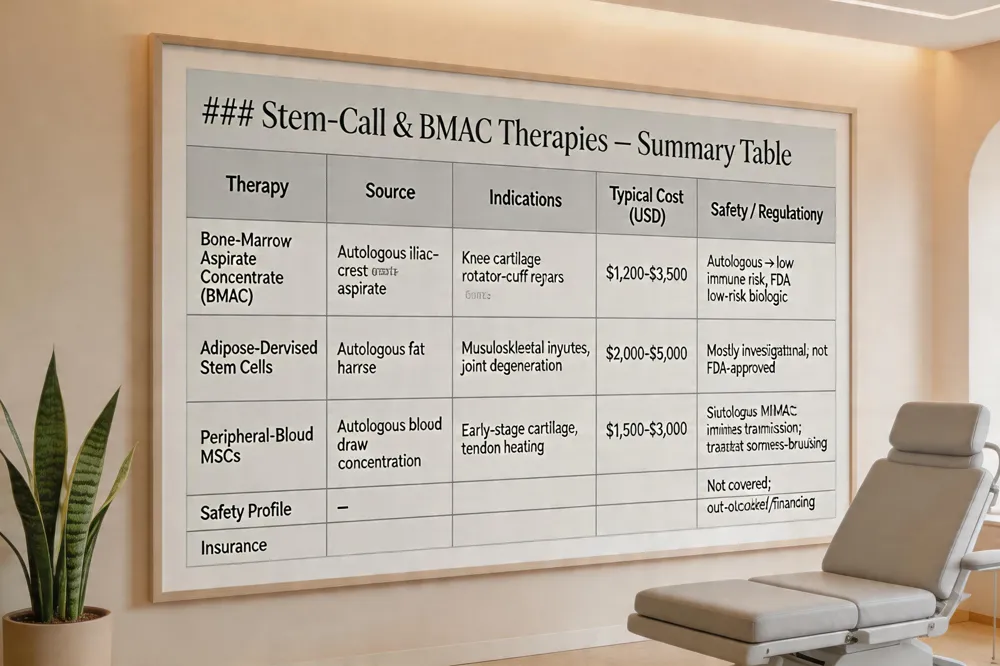 Bone‑marrow aspirate concentrate (BMAC) harvests a mixture of platelets, white‑blood cells, and mesenchymal stem cells (MSCs) from the patient’s iliac crest. MSCs can differentiate into cartilage, bone, tendon, and ligament tissue, while the accompanying growth‑factor‑rich plasma modulates inflammation and promotes angiogenesis. Emerging clinical data support BMAC for knee cartilage lesions, rotator‑cuff repairs, and chronic tendinopathies, with a 2016 Orthopaedic Journal of Sports Medicine trial showing significant pain and functional gains versus standard care. High‑profile athletes such as Tiger Woods, Rafael Nadal, and Kobe Bryant have publicly credited PRP and stem‑cell injections for faster recoveries, and NFL star Troy Polamalu used PRP after a calf strain. Safety profiles are favorable: autologous products minimize immune reaction and disease transmission, and complications are usually limited to transient soreness or bruising. The FDA classifies minimally manipulated autologous cells as low‑risk biologics, but most stem‑cell applications remain investigational and are not covered by insurance.
Stem cell therapy for sports injuries: Autologous MSCs harvested from bone‑marrow, adipose tissue, or peripheral blood are concentrated and injected or surgically placed to reduce inflammation and stimulate regeneration. While promising, long‑term outcomes are still under study and FDA approval is limited.
Where did Peyton Manning go for stem cell therapy? He sought treatment in Germany, returning to win another Super Bowl before retiring at age 40.
Do NFL players get PRP injections? Yes; Troy Polamalu is one example, using PRP after a calf strain to accelerate healing.
Regenerative sports medicine Santa Monica: Regenerative & Sports Medicine (Dr. Rand McClain, DO) at 2701 Ocean Park Blvd offers PRP, IV nutrition, cryotherapy, NAD⁺, and bioidentical hormone therapy, emphasizing a patient‑centered, non‑surgical approach to rapid, sustainable recovery.
Non‑Surgical Treatment Strategies and Recovery Timelines
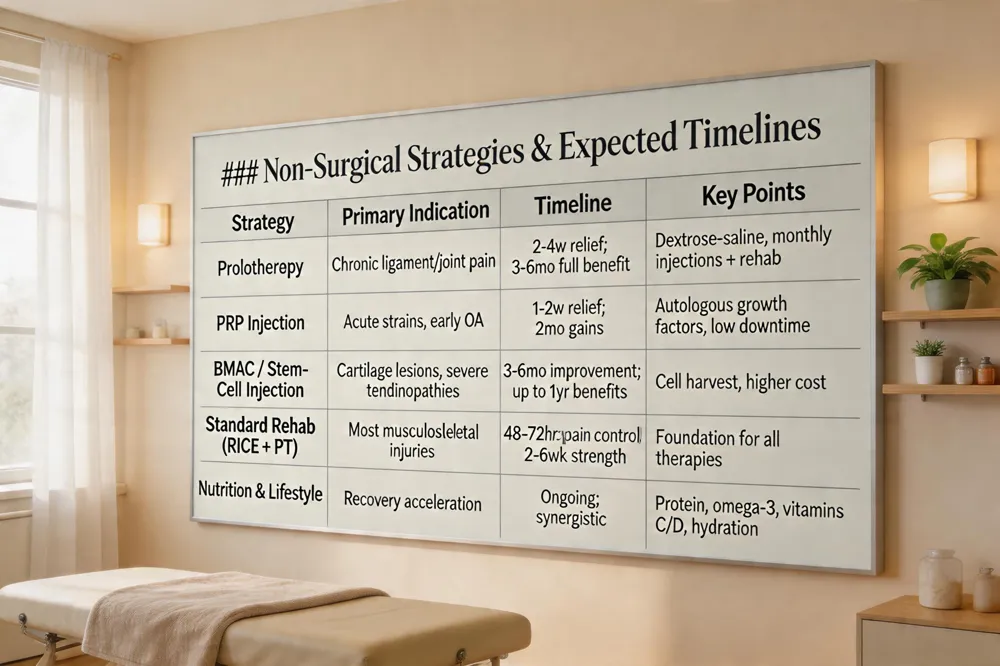
Non‑Surgical Strategies & Expected Timelines
| Strategy | Primary Indication | Typical Timeline to Noticeable Effect | Key Points |
|---|---|---|---|
| Prolotherapy | Chronic ligament/tendon/joint pain (e.g., low‑back OA, shoulder OA, tendinopathy) | Pain reduction often within 2‑4 weeks; full benefit 3‑6 months with multiple injections | Uses dextrose‑saline to provoke mild inflammation → new collagen. Requires series of monthly injections + rehab. |
| PRP Injection | Acute muscle strains, tendinopathies, early OA | Early pain relief 1‑2 weeks; functional gains assessed at 2 months | Autologous growth factors; minimal downtime. |
| BMAC / Stem‑Cell Injection | Cartilage lesions, severe tendinopathies | Significant improvement usually 3‑6 months; benefits may continue up to 1 year | Requires cell harvest; higher cost; investigational for many uses. |
| Standard Rehab (RICE + PT) | Most musculoskeletal injuries | Initial pain control 48‑72 hrs; progressive ROM & strength 2‑6 weeks | Foundation for all regenerative therapies; essential for optimal outcomes. |
| Nutrition & Lifestyle Optimization | Recovery acceleration | Ongoing; synergistic with other treatments | Adequate protein, omega‑3, vitamins C/D, hydration; supports tissue repair. |
 Prolotherapy
, also called proliferation or regenerative injection therapy, uses a concentrated dextrose‑saline solution (often with a local anesthetic) to provoke a mild inflammatory response in weakened ligaments, tendons, or joints. The irritant “jump‑starts” the body’s natural healing cascade, promoting new collagen formation and strengthening connective tissue. It is most commonly offered for chronic musculoskeletal pain such as low‑back pain, osteoarthritis of the knee or shoulder, tendinopathy, and sacroiliac joint discomfort when patients wish to avoid surgery. Treatments are performed outpatient, typically a series of monthly injections over several months combined with a rehab program. Side effects are usually limited to temporary soreness, bruising, or rare infection.
Prolotherapy
Prolotherapy, also called proliferation or regenerative injection therapy, uses a concentrated dextrose‑saline solution (often with a local anesthetic) to provoke a mild inflammatory response in weakened ligaments, tendons, or joints. The irritant “jump‑starts” the body’s natural healing cascade, promoting new collagen formation and strengthening connective tissue. It is most commonly offered for chronic musculoskeletal pain such as low‑back pain, osteoarthritis of the knee or shoulder, tendinopathy, and sacroiliac joint discomfort when patients wish to avoid surgery. Treatments are performed outpatient, typically a series of monthly injections over several months combined with a rehab program. Side effects are usually limited to temporary soreness, bruising, or rare infection.
How long does it take for regenerative therapy to work? Regenerative therapies are not instant. For acute injuries, many patients notice reduced pain and improved function within a few weeks. PRP injections are usually reassessed at two months; stem‑cell or BMAC treatments often require three‑to‑six months before meaningful improvement appears, with benefits continuing for up to a year. Chronic conditions may need multiple sessions over several months.
How to heal a torn muscle without surgery?
- Apply RICE (rest, ice, compression, elevation) for the first 48‑72 hours.
- Initiate a structured PT program focusing on low‑impact ROM, progressive stretching, and light strengthening to prevent scar tissue.
- Consider PRP injections to deliver concentrated growth factors that accelerate repair and reduce inflammation.
- Optimize nutrition (protein, omega‑3, vitamin C/D) and stay hydrated.
- Gradually return to sport under clinician supervision, monitoring for re‑injury.
How to speed up sports‑injury recovery? Combine immediate RICE with early, pain‑free movement, a nutrient‑rich diet, and a progressive PT regimen. Add biologic injections such as PRP or BMAC to modulate inflammation and enhance tissue regeneration. A patient‑centered, multimodal approach—integrating regenerative injections, targeted rehab, and lifestyle optimization—shortens downtime and promotes a faster, safer return to sport.
Finding the Right Non‑Surgical Regenerative Care
![### How to Locate Quality Non‑Surgical Regenerative Care – Quick Reference
| Search Tip | Example Provider | Services Offered | Location |
|---|---|---|---|
| Search “PRP therapy near [city]” and verify orthopedists use FDA‑regulated protocols. | Dr. Jaimal Sangha – Sports Medicine Clinic | PRP, BMAC, viscosupplementation, comprehensive exam, injection, rehab plan | Washington, DC area |
| Look for “Regenerative sports medicine [city]” for multidisciplinary clinics. | Regenerative & Sports Medicine – Dr. Rand McClain, DO | PRP, IV nutrition, cryotherapy, NAD⁺, bioidentical hormone therapy, TenJet | Santa Monica, CA (2701 Ocean Park Blvd.) |
| Verify credentials: board‑certified orthopedist, fellowship in sports medicine, peer‑reviewed publications. | — | — | — |
| Check financing options: cash discounts, HSA/FSA, multi‑session packages. | — | — | — |
| Confirm insurance coverage or out‑of‑pocket estimates before scheduling. | — | — | — |
| Search “PRP therapy near [city]” and verify orthopedists or doctors using products. In the DC area, Sports Medicine provide PRP, BMAC, and TenJet. Dr. Jaimal Sangha’s clinic follows a plan: exam, injection, and rehab that limits medication. Insurance coverage varies; many offices offer financing. |
Medicine near me – search for “PRP therapy” and choose providers.
Regenerative sports medicine Santa Monica – Regenerative & Sports Medicine, 2701 Ocean Park Blvd., led by Dr. Rand McClain, offers PRP and cryotherapy.
Do NFL players get PRP injections? – Yes, Troy Polamalu used PRP to speed recovery quickly.
Choosing a Conservative, Regenerative Path Forward
Regenerative therapies such as PRP and BMAC offer athletes faster tissue repair, reduced inflammation, and low‑risk, autologous safety profiles—no immune rejection or disease transmission. By tailoring injections, imaging guidance, and a structured rehab program to each individual’s injury, we preserve natural joint health without surgery. Ready to accelerate your recovery? Call Dr. Jaimal Sangha’s office today to schedule a personalized, non‑surgical consultation and begin your journey toward peak performance today.