Introduction to Regenerative Sports Medicine
Stem cell therapy is a minimally invasive, biologic treatment that harvests autologous mesenchymal cells cells from bone marrow, adipose tissue, or peripheral blood, concentrates them, and injects them into damaged musculoskeletal structures to stimulate regeneration and modulate inflammation. Unlike traditional surgery, which removes or replaces tissue through incisions, grafts, or hardware, stem cell injections preserve native anatomy, require only outpatient ultrasound‑guided placement, and avoid the postoperative pain, infection risk, and lengthy rehabilitation associated with operative repairs. Advanced Integrative Medicine embraces a patient‑centered philosophy, tailoring regenerative protocols to each athlete’s injury pattern, performance goals, and recovery timeline while integrating structured physical therapy, nutrition, and education to optimize natural healing pathways.
Understanding Stem Cell Therapy for Sports Injuries
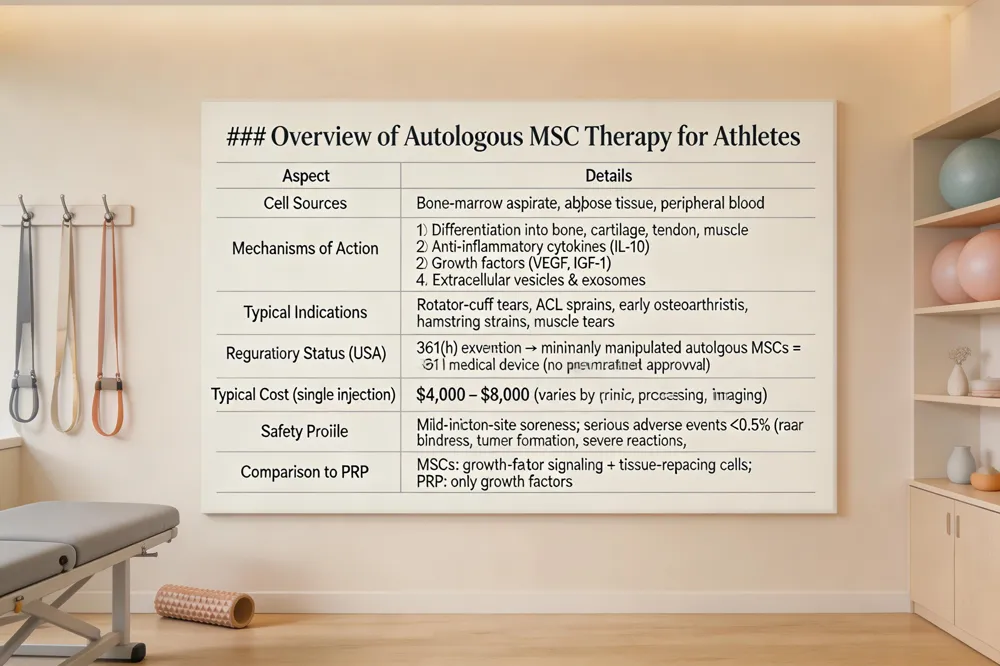
Overview of Autologous MSC Therapy for Athletes
| Aspect | Details |
|---|---|
| Cell Sources | Bone‑marrow aspirate, adipose tissue, peripheral blood |
| Mechanisms of Action | 1️⃣ Differentiation into bone, cartilage, tendon, muscle <br>2️⃣ Secretion of anti‑inflammatory cytokines (e.g., IL‑10) <br>3️⃣ Release of growth factors (VEGF, IGF‑1) <br>4️⃣ Extracellular vesicles & exosomes that modulate micro‑environment |
| Typical Indications | Rotator‑cuff tears, ACL sprains, early‑stage osteoarthritis, hamstring strains, muscle tears |
| Regulatory Status (USA) | 361(h) exemption → minimally manipulated autologous MSCs are classified as a 361 medical device (no pre‑market approval required) |
| Typical Cost (single injection) | $4,000 – $8,000 (varies by clinic, processing, imaging guidance) |
| Safety Profile | Mostly mild injection‑site soreness; serious adverse events <0.5 % (rare blindness, tumor formation, severe reactions) |
| Comparison to PRP | MSCs provide both growth‑factor signaling and tissue‑replacing cells; PRP only supplies growth factors |
 Stem cell therapy for musculoskeletal injury uses the athlete’s own adult mesenchymal stem cells (MSCs), harvested from bone‑marrow aspirate, adipose tissue, or peripheral blood, concentrated, and injected directly into damaged muscle, tendon, cartilage, or joint. MSCs act by differentiating into target tissues and by secreting anti‑inflammatory cytokines, growth factors (e.g., VEGF, IGF‑1), and extracellular vesicles that modulate the injury micro‑environment, promote angiogenesis, and recruit endogenous repair cells. This dual mechanism reduces pain, limits swelling, and accelerates functional recovery, often allowing a return to sport weeks faster than conventional rehab alone.
Stem cell therapy for athletes – Autologous MSCs provide a tissue‑preserving, minimally invasive option that can shorten healing timelines for rotator‑cuff tears, ACL sprains, and early‑stage osteoarthritis. Although no FDA‑approved product exists specifically for sports injuries, the 361(h) exemption permits minimally manipulated autologous cells to be used under physician oversight, making the treatment legal but still experimental.
Mesenchymal stem cells – MSCs are multipotent stromal cells capable of becoming bone, cartilage, tendon, and muscle. Their immunomodulatory secretome and differentiation potential make them attractive for non‑surgical orthopaedic care, with a favorable safety profile (most adverse events are mild injection‑site soreness).
Cost – A single autologous MSC injection typically ranges from $4,000 to $8,000 in the United States, with additional fees for processing, imaging guidance, and combined PRP. Prices vary by clinic, cell source, and number of treated sites.
Comparison with PRP – PRP delivers concentrated platelets that release growth factors to jump‑start healing, whereas MSCs provide both growth‑factor signaling and the capacity to replace lost tissue. Combining PRP with MSCs is thought to enhance cell viability and matrix deposition, offering synergistic benefits for athletes seeking a conservative, patient‑centered recovery pathway.
Clinical Evidence, Patient Stories, and Cost Comparison
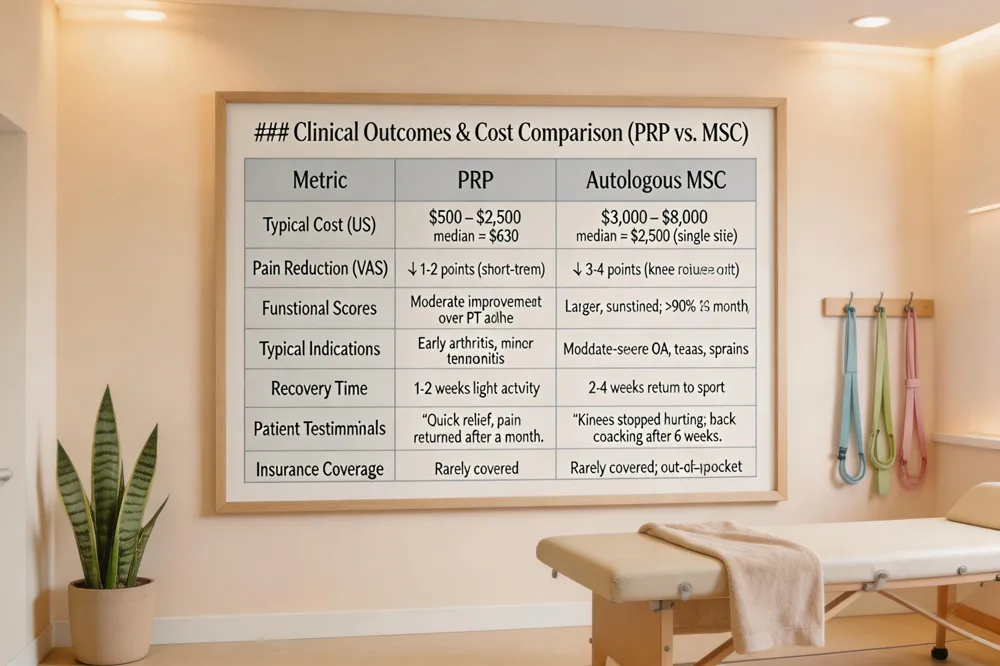
Clinical Outcomes & Cost Comparison (PRP vs. MSC)
| Metric | PRP | Autologous MSC |
|---|---|---|
| Typical Cost (US) | $500 – $2,500 median ≈ $630 | $3,000 – $8,000 median ≈ $2,500 (single site) |
| Pain Reduction (VAS) | ↓ 1‑2 points (short‑term) | ↓ 3‑4 points (studies on knee OA, rotator‑cuff, hamstring) |
| Functional Scores (e.g., WOMAC, IKDC) | Moderate improvement over PT alone | Larger, sustained improvements; some patients report >90 % functional gain within 2 months |
| Typical Indications | Early‑stage arthritis, minor tendonitis | Moderate‑to‑severe OA, rotator‑cuff tears, ACL sprains, muscle strains |
| Recovery Time | 1‑2 weeks to resume light activity | 2‑4 weeks to return to sport (often faster than PT alone) |
| Patient Testimonials | “Quick relief, but pain returned after a month.” | “Knees stopped hurting; back coaching again after 6 weeks.” |
| Insurance Coverage | Rarely covered | Rarely covered; often out‑of‑pocket |
 Pain and functional improvements reported in trials: Randomized studies show intra‑articular MSC injections reduce pain scores (e.g., VAS ↓ 3‑4 points) and boost function in knee osteoarthritis, rotator‑cuff tears, and hamstring strains, often outperforming physical therapy alone.
Patient testimonials and real‑world outcomes: Athletes describe rapid, lasting relief and a return to sport. A former football coach noted his knees stopped hurting and he could coach again; a spinal‑cord‑injury survivor reported disappearance of shoulder and knee pain. A North Carolina knee‑pain patient achieved 90 % improvement within two months, walking stairs and lying on her side pain‑free.
Cost differences between PRP injections and stem‑cell treatments: PRP injections cost roughly $500‑$2,500 (median $630). Stem‑cell injections range $3,000‑$8,000+ (median $2,500), reflecting harvest, lab processing, and imaging guidance.
Efficacy for arthritis and knee conditions: PRP provides short‑term inflammation control and is best for early‑stage arthritis. Stem‑cell therapy introduces undifferentiated cells that can regenerate cartilage and bone, offering longer‑lasting symptom reduction and possible tissue restoration in moderate‑to‑severe knee disease.
Overall, conservative, patient‑centered option that can accelerate healing, reduce pain, and potentially lower the need for surgery, especially for athletes seeking quicker return to play.
Regulatory Landscape, Anti‑Doping Rules, and Safety
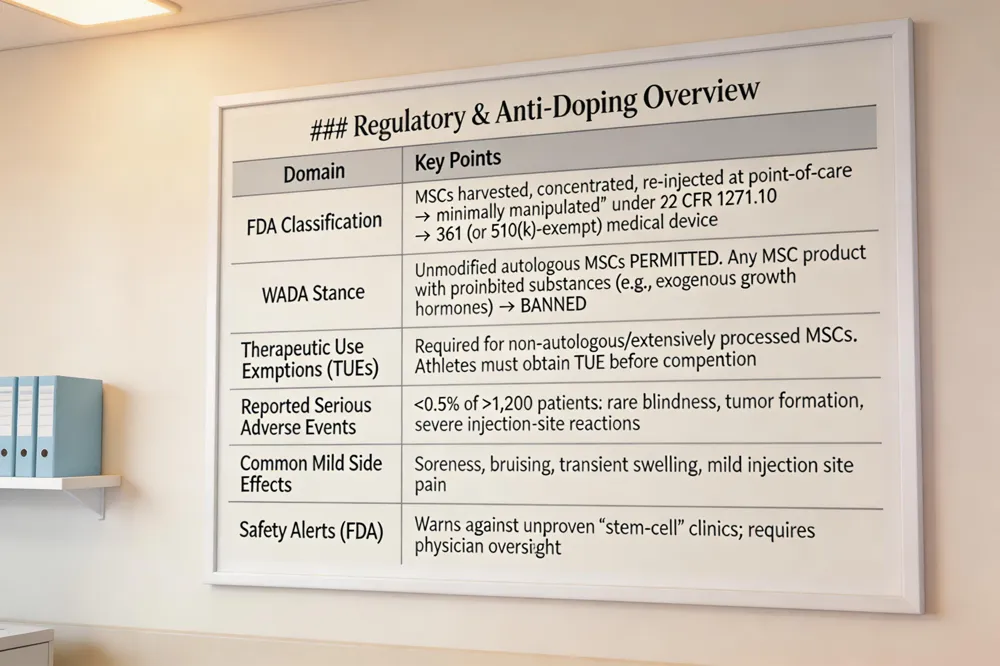
Regulatory & Anti‑Doping Overview
| Domain | Key Points |
|---|---|
| FDA Classification | MSCs harvested, concentrated, and re‑injected at point‑of‑care → minimally manipulated under 21 CFR 1271.10 → 361 (or 510(k)‑exempt) medical device |
| WADA Stance | Unmodified autologous MSCs permitted. Any MSC product that contains prohibited substances (e.g., exogenous growth hormones) or is engineered for performance enhancement is banned |
| Therapeutic Use Exemptions (TUEs) | Required when MSCs are non‑autologous, extensively processed, or contain a prohibited agent. Athletes must obtain TUE before competition |
| Reported Serious Adverse Events | <0.5 % of >1,200 treated patients: rare blindness, tumor formation, severe injection‑site reactions |
| Common Mild Side Effects | Soreness, bruising, transient swelling, mild pain at injection site |
| Safety Alerts (FDA) | Warns against unproven “stem‑cell” clinics that market unregulated products; emphasizes need for physician oversight |
 FDA classification of minimally manipulated autologous MSCs – In the United States, autologous mesenchymal stem cells (MSCs) that are harvested, concentrated, and re‑injected at the point of care are considered “minimally manipulated” under 21 CFR 1271.10 and are classified as 361 (or 510(k)‑exempt) medical devices. This exemption allows orthopedic physicians to use MSCs for sports‑medicine indications without a pre‑market approval, provided the cells are not expanded or substantially altered.
World Anti‑Doping Agency (WADA) prohibitions – WADA bans any stem‑cell product that is modified with prohibited substances (e.g., growth hormones, exogenous growth factors) or that provides a performance‑enhancing effect. Unmodified, autologous MSC injections are generally permitted, but athletes must verify that no banned agents are added.
Therapeutic Use Exemptions (TUEs) for athletes – When a stem‑cell preparation is non‑autologous, extensively processed, or contains a prohibited substance, a TUE may be required. Athletes should consult their sport’s anti‑doping authority and the USADA Drug Reference Team before treatment.
Safety warnings and reported adverse events – The FDA has issued safety alerts about unproven stem‑cell products, citing rare serious events such as blindness, tumor formation, and severe injection‑site reactions. Across >1,200 treated patients, serious adverse events are <0.5 %; most side effects are mild soreness, bruising, or transient swelling.
Sports injury doctor near me – Dr. Jaimal Sangha at Advanced Integrative Medicine specializes in non‑surgical regenerative care, offering autologous MSC and PRP injections with a conservative, patient‑centered approach. Dr. Jaimal Sangha
Regenerative & Sports Medicine California – Clinics in Santa Monica and Tarzana provide outpatient MSC, PRP, and BMAC therapies, emphasizing rapid return‑to‑play while avoiding surgery.
Stem cell therapy for athletes – Autologous MSCs harvested from bone marrow or adipose tissue can reduce inflammation and accelerate tendon, ligament, and cartilage repair, though FDA approval for sports‑specific indications is pending. Stem cell therapy for athletes
Primary care sports medicine – Primary‑care physicians integrate regenerative biologics, targeted rehab, and injury‑prevention strategies to manage athletic injuries conservatively.
Regenerative sports medicine Santa Monica – Practices like Regenerative & Sports Medicine (Dr. Rand McClain) combine PRP, MSC injections, and adjunctive modalities (e.g., cryotherapy) to support tissue healing and performance.
Finding Care, Practical Logistics, and Financial Planning
Practical Logistics for Athletes Seeking Regenerative Care
| Aspect | Details |
|---|---|
| Typical Procedure Duration | 45 minutes (outpatient, ultrasound‑guided) |
| Key Clinics (US) | • Dr. Jaimal Sangha – Advanced Integrative Medicine (Chicago suburbs) <br>• NYU Langone Sports Medicine (NYC) <br>• Regenerative & Sports Medicine – Santa Monica & Tarzana, CA |
| Appointment Workflow | 1️⃣ Initial consult (history, imaging) <br>2️⃣ Consent & insurance/financing discussion <br>3️⃣ Harvest (bone‑marrow or adipose) <br>4️⃣ Processing (≈30 min) <br>5️⃣ Injection under imaging guidance <br>6️⃣ Post‑procedure rehab plan |
| Financing Options | • Payment plans (0‑interest 6‑12 mo) <br>• Health‑savings accounts (HSA/FSA) <br>• Limited third‑party financing (e.g., CareCredit) |
| Insurance Coverage | Generally not covered for elective regenerative procedures; may be reimbursed if deemed medically necessary by a physician and pre‑authorized |
| Patient Portal | Secure HIPAA‑compliant portal for scheduling, tele‑health, record review, and recovery milestone tracking |
| Cost Range (US) | PRP: $500‑$2,500 <br>MSC: $4,000‑$8,000 <br>Combined protocols: $5,000‑$30,000 (depends on number of sites & adjuncts) |
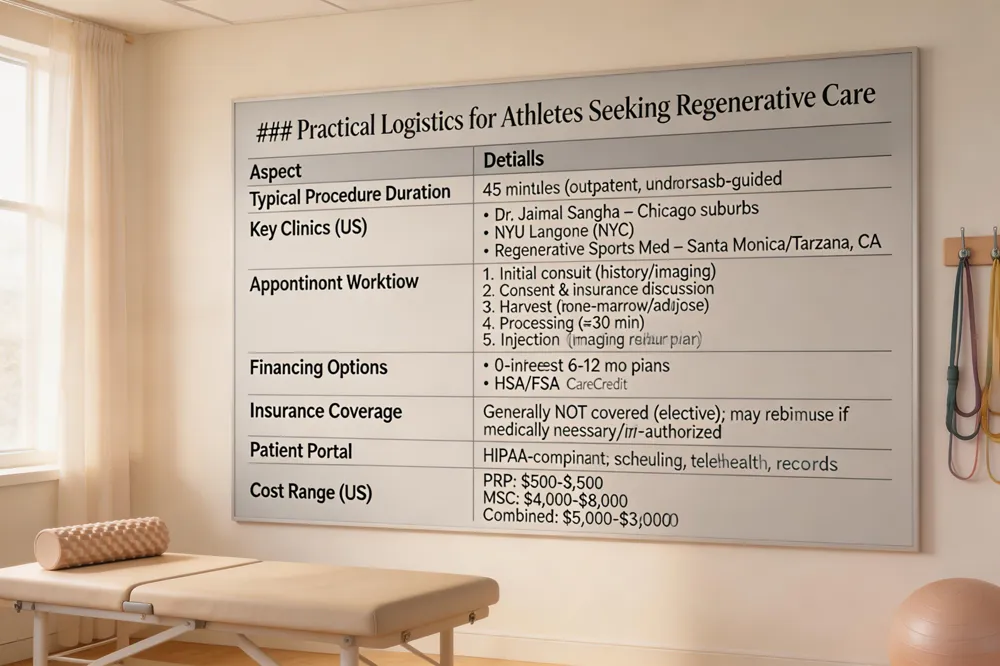 When you search for "PRP" and "stem cell therapy" near me, start with local regenerative‑medicine clinics that specialize in non‑surgical musculoskeletal care. In major metros you’ll find practices offering both platelet‑rich plasma injections and autologous mesenchymal stem‑cell (MSC) therapy for tendon, ligament, cartilage, and muscle injuries. Verify the provider’s orthopedic, the preparation protocol (e.g., Hackett‑and‑Hemwall for PRP), and post‑procedure rehabilitation plans before scheduling.
For "orthopedic stem cell therapy near me," clinics such as Dr. Jaimal Sangha’s Sports Medicine Center (serving Chicago suburbs) perform minimally invasive, ultrasound‑guided MSC injections harvested from bone‑marrow or adipose tissue. The procedure is outpatient, 45 minutes, and aims to reduce pain, improve function, and delay surgery.
NYU Langone Sports Medicine offers a comprehensive, patient‑centered model that blends surgical expertise with conservative options like PRP, BMAC, and structured physical therapy. The center provides same‑day appointments and multidisciplinary concussion care.
The Regenerative Sports Medicine Patient Portal is a secure, HIPAA‑compliant platform for scheduling in‑person or tele‑health visits, reviewing records, messaging clinicians, and tracking recovery milestones.
Cost varies: a single PRP injection runs $500‑$2,500; autologous MSC injections $4,000‑$8,000; combined protocols $5,000‑$30,000. A typical stem‑cell session falls between $1,300‑$8,500. Financing options and limited insurance coverage are common, so discuss payment plans during the initial consult.
Future Directions, Emerging Technologies, and Research Opportunities
Emerging Research & Technology Roadmap
| Research Theme | Potential Impact |
|---|---|
| Integrating Regeneration into Training | Embedding PRP/MSCs into warm‑up & cool‑down cycles to pre‑empt micro‑tears; could reduce acute injuries by 10‑15 % |
| Biomarker‑Guided Patient Selection | Use cytokine panels, MRI T2 mapping, or genetic markers to identify athletes most likely to benefit from MSC therapy |
| Scaffold‑Based Delivery | 3‑D printed biodegradable scaffolds seeded with autologous MSCs for tendon/ligament repair → improved cell engraftment & load‑bearing capacity |
| Exosome & Extracellular Vesicle Therapics | Cell‑free MSC‑derived exosomes delivering miRNAs to modulate inflammation; may become off‑the‑shelf product with fewer regulatory hurdles |
| CRISPR‑Enhanced MSCs | Gene‑editing to up‑regulate cartilage‑specific genes (SOX9) → accelerated cartilage regeneration in OA |
| Long‑Term Outcomes Registry | 5‑10 year follow‑up on functional scores (WOMAC, IKDC), re‑operation rates, and neoplastic events; standardized data collection across centers |
| Large‑Scale RCTs | Multicenter trials comparing PRP, MSC, BMAC, and standard rehab; primary endpoints: time to return‑to‑play, pain reduction, cost‑effectiveness |
 Research topics for athletic training
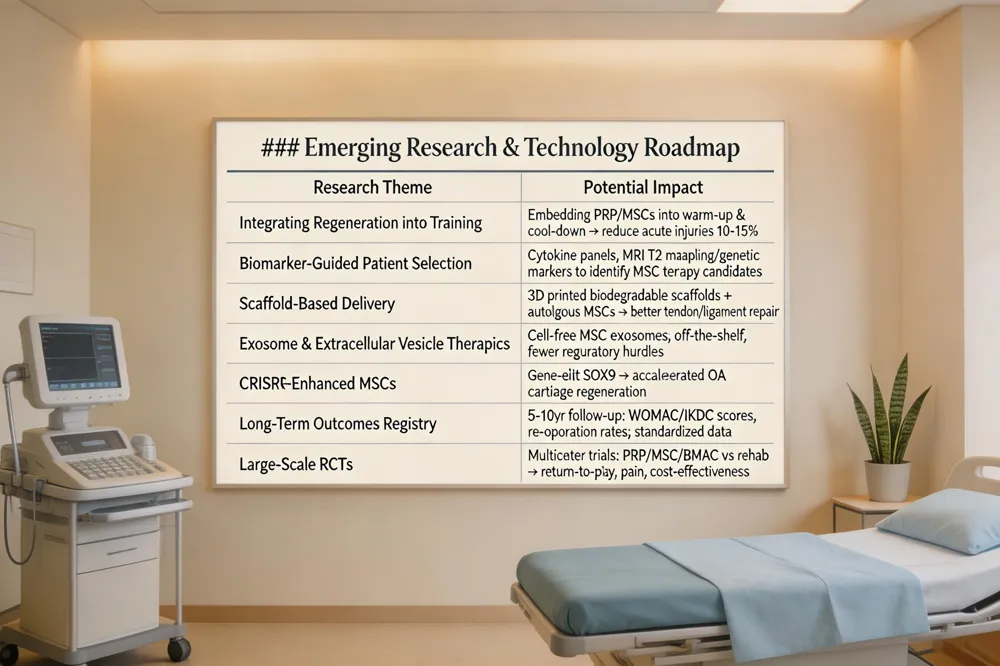
Investigations should focus on integrating regenerative modalities—such as platelet‑rich plasma (PRP) and mesenchymal stem‑cell (MSC) injections—into warm‑up, cool‑down, and periodization protocols to reduce acute muscle tears and chronic tendinopathies. Studies evaluating personalized nutrition, supplementation, and biomechanical assessments that enhance tissue repair while minimizing invasive surgery are also needed. Longitudinal trials tracking integrative approaches (regenerative medicine + strength‑conditioning) will clarify impacts on career longevity.
Research topics for athletic training
Investigations should focus on integrating regenerative modalities—such as platelet‑rich plasma (PRP) and mesenchymal stem‑cell (MSC) injections—into warm‑up, cool‑down, and periodization protocols to reduce acute muscle tears and chronic tendinopathies. Studies evaluating personalized nutrition, supplementation, and biomechanical assessments that enhance tissue repair while minimizing invasive surgery are also needed. Longitudinal trials tracking integrative approaches (regenerative medicine + strength‑conditioning) will clarify impacts on career longevity.
Sports medicine research opportunities Large‑scale, multicenter randomized controlled trials comparing non‑surgical biologics (PRP, MSC, BMAC) against standard rehabilitation can generate high‑quality evidence. Biomarker‑guided patient selection—using inflammatory cytokine panels, imaging signatures, or genetic markers—will personalize therapy and improve outcomes. Collaborative registries at institutions like Mayo Clinic and ASMI enable observational studies and comparative effectiveness research.
Scaffold‑based delivery, exosomes, and gene‑editing Emerging technologies include 3‑D printed scaffolds seeded with MSCs, extracellular‑vesicle (exosome) therapeutics that deliver micro‑RNAs, and CRISPR‑mediated gene editing to boost cell potency. These strategies aim to enhance cell engraftment, accelerate matrix synthesis, and provide off‑the‑shelf allogeneic products.
Long‑term efficacy and safety monitoring Extended follow‑up (5‑10 years) is essential to assess durability of functional gains, incidence of neoplastic transformation, and need for subsequent surgery. Standardized outcome metrics (WOMAC, IKDC, VAS) and adverse‑event registries will inform regulatory guidance and clinical best practices.
Conclusion – Embracing a Conservative, Regenerative Future
Stem cell and PRP therapies offer evidence‑backed pain relief, faster tissue healing, and reduced surgery rates for athletes, while preserving natural biomechanics. Personalized, patient‑centered protocols ensure safe, minimally invasive care. Athletes should explore these regenerative options, consult qualified clinicians, and prioritize conservative, biologic treatment pathways for long‑term performance and joint health outcomes today.