Why Personalized Care Matters
Personalized care transforms health delivery from a reactive, disease‑centric system to a proactive model that anticipates risk and promotes wellness. By using genetic, phenotypic, and lifestyle information, clinicians can predict individual susceptibility to conditions before symptoms appear, enabling early interventions that curb disease progression. At the same time, patients become active partners; shared decision‑making empowers them to set personal goals, choose therapies that align with their values, and stay engaged in their own health journey. Digital platforms—electronic health records, wearable sensors, and AI analytics—aggregate genomics, behavior, and environmental data into a single, secure profile. This integration fuels precise risk assessments, tailored preventive plans, and real‑time adjustments, ensuring that care is both evidence‑based and truly individualized. This approach benefits patients across all ages, fostering long‑term health resilience.
Foundations of Patient‑Centered Care
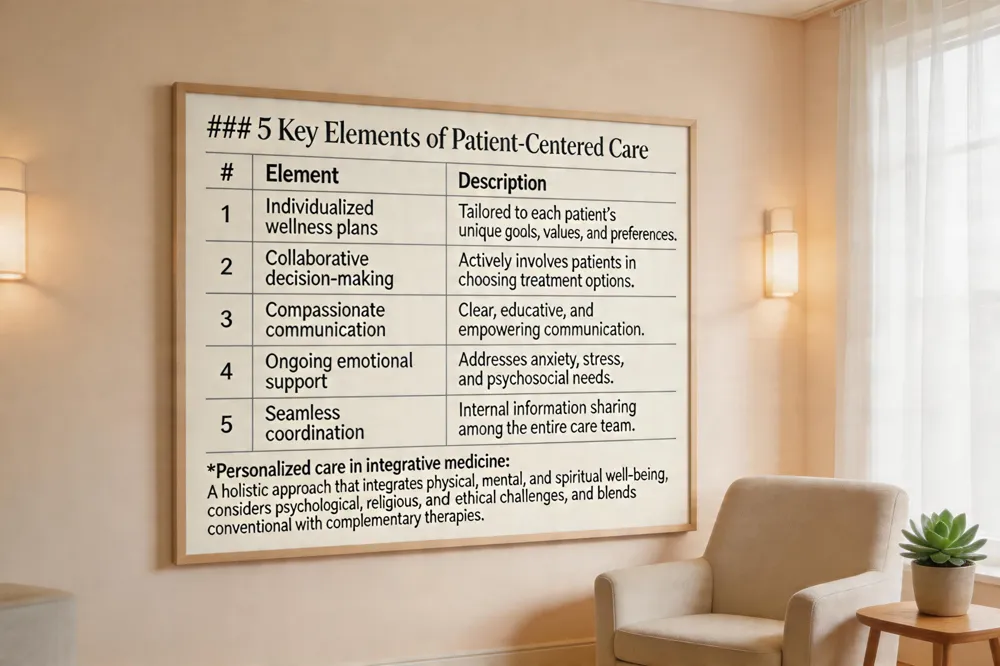
5 Key Elements of Patient‑Centered Care
| # | Element | Description |
|---|---|---|
| 1 | Individualized wellness plans | Tailored to each patient’s unique goals, values, and preferences. |
| 2 | Collaborative decision‑making | Actively involves patients in choosing treatment options. |
| 3 | Compassionate communication | Clear, educative, and empowering communication. |
| 4 | Ongoing emotional support | Addresses anxiety, stress, and psychosocial needs. |
| 5 | Seamless coordination | Internal information sharing among the entire care team. |
Personalized care in integrative medicine: A holistic approach that integrates physical, mental, and spiritual well‑being, considers psychological, religious, and ethical challenges, and blends conventional with complementary therapies.
 What are the 5 key elements of patient‑centered care?
- Individualized wellness plans reflecting each patient’s unique goals, values, and preferences.
- Collaborative decision‑making that actively involves patients in choosing treatment options.
- Compassionate, clear communication that educates and empowers.
- Ongoing emotional support addressing anxiety, stress, and psychosocial needs.
- Seamless coordination and internal information sharing among the entire care team.
What is personalized care in the context of integrative medicine?
Personalized care in integrative medicine is a holistic approach that tailors interventions to an individual’s physical, mental, and spiritual well‑being, considering psychological, religious, and ethical challenges while integrating conventional and complementary therapies for a truly patient‑focused plan.
Integrative Medicine Hubs – Cedars‑Sinai and UCLA
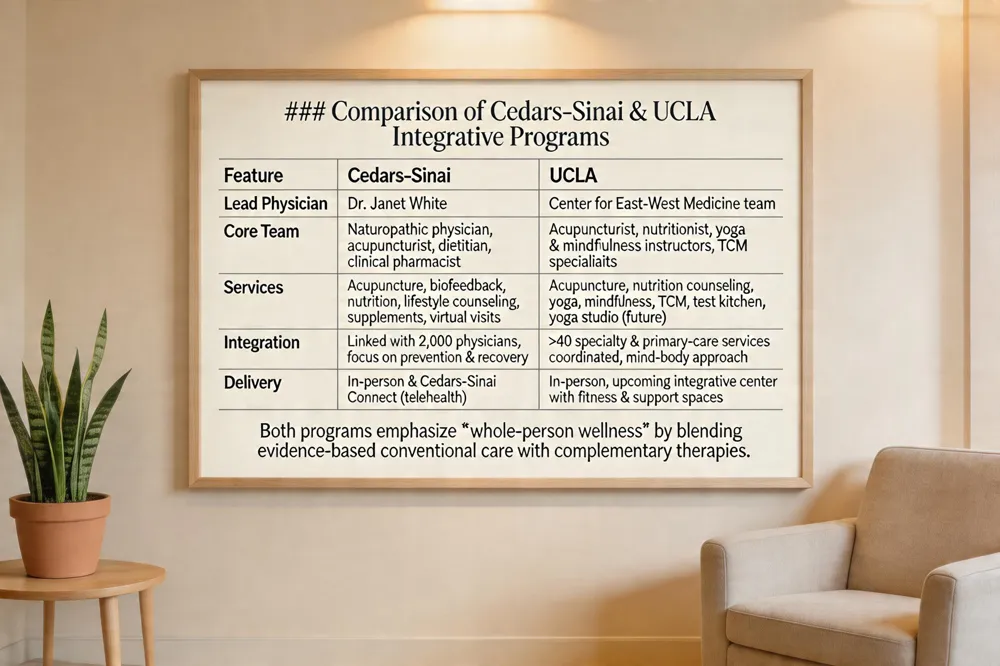
Comparison of Cedars‑Sinai & UCLA Integrative Programs
| Feature | Cedars‑Sinai | UCLA |
|---|---|---|
| Lead Physician | Dr. Janet White | Center for East‑West Medicine team |
| Core Team | Naturopathic physician, acupuncturist, dietitian, clinical pharmacist | Acupuncturist, nutritionist, yoga & mindfulness instructors, TCM specialists |
| Services | Acupuncture, biofeedback, nutrition, lifestyle counseling, supplements, virtual visits | Acupuncture, nutrition counseling, yoga, mindfulness, TCM, test kitchen, yoga studio (future) |
| Integration | Linked with 2,000 physicians, focus on prevention & recovery | >40 specialty & primary‑care services coordinated, mind‑body approach |
| Delivery | In‑person & Cedars‑Sinai Connect (telehealth) | In‑person, upcoming integrative center with fitness & support spaces |
Both programs emphasize whole‑person wellness by blending evidence‑based conventional care with complementary therapies.
 Integrative Medicine Cedars‑Sinai
Cedars‑Sinai’s Integrative Health Program blends evidence‑based conventional medicine with holistic, minimally invasive therapies to support whole‑person wellness. Led by Dr. Janet White, the team includes a naturopathic physician, acupuncturist, dietitian, and clinical pharmacist. Services such as acupuncture, biofeedback, nutrition, lifestyle counseling, and supplements are personalized to each patient’s physical, emotional, mental, and spiritual needs. Integrated with the hospital’s network of 2,000 physicians, the program focuses on illness prevention and optimized recovery, and adjunctive care, offered via virtual visits and Cedars‑Sinai Connect.
Integrative Medicine Cedars‑Sinai
Cedars‑Sinai’s Integrative Health Program blends evidence‑based conventional medicine with holistic, minimally invasive therapies to support whole‑person wellness. Led by Dr. Janet White, the team includes a naturopathic physician, acupuncturist, dietitian, and clinical pharmacist. Services such as acupuncture, biofeedback, nutrition, lifestyle counseling, and supplements are personalized to each patient’s physical, emotional, mental, and spiritual needs. Integrated with the hospital’s network of 2,000 physicians, the program focuses on illness prevention and optimized recovery, and adjunctive care, offered via virtual visits and Cedars‑Sinai Connect.
Integrative medicine UCLA UCLA Health’s integrative medicine program combines Western care with complementary modalities—acupuncture, nutrition counseling, yoga, mindfulness, and traditional Chinese medicine through the Center for East‑West Medicine. The Integrative Medicine Collaborative coordinates >40 specialty and primary‑care services, emphasizing a mind‑body approach. The forthcoming UCLA Health Center for Integrative Medicine will feature a test kitchen, yoga studio, fitness center, and support‑group spaces, all designed to promote lifestyle‑based healing, disease prevention, and recovery.
Los Angeles Integrative Landscape
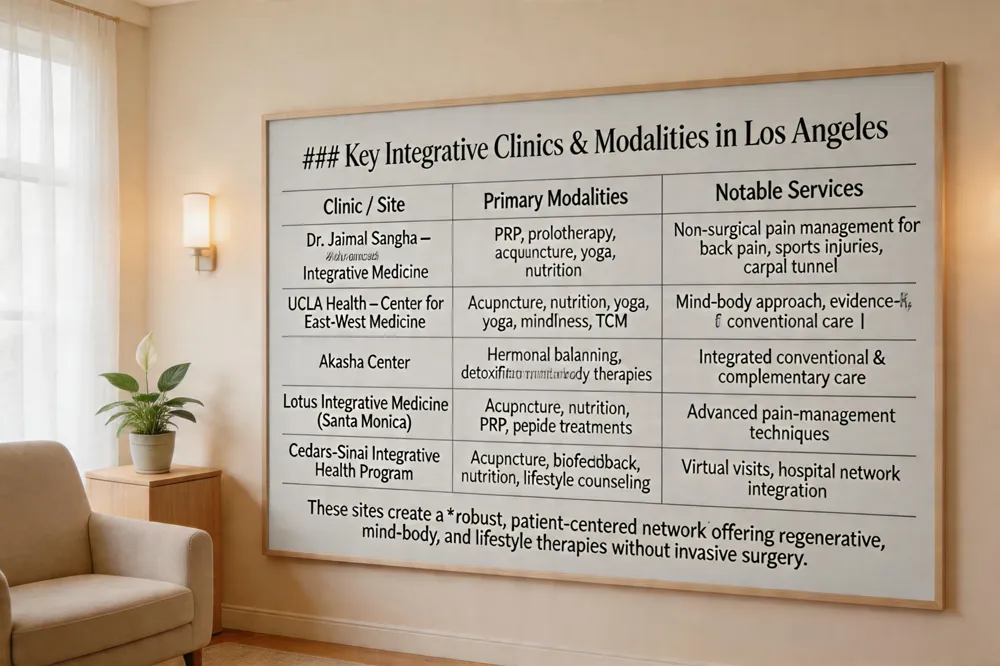
Key Integrative Clinics & Modalities in Los Angeles
| Clinic / Site | Primary Modalities | Notable Services |
|---|---|---|
| Dr. Jaimal Sangha – Advanced Integrative Medicine | PRP, prolotherapy, acupuncture, yoga, nutrition | Non‑surgical pain management for back pain, sports injuries, carpal tunnel |
| UCLA Health – Center for East‑West Medicine | Acupuncture, nutrition, yoga, mindfulness, TCM | Mind‑body approach, evidence‑based conventional care |
| Akasha Center | Hormonal balancing, detoxification, mind‑body therapies | Integrated conventional & complementary care |
| Lotus Integrative Medicine (Santa Monica) | Acupuncture, nutrition, PRP, peptide treatments | Advanced pain‑management techniques |
| Cedars‑Sinai Integrative Health Program | Acupuncture, biofeedback, nutrition, lifestyle counseling | Virtual visits, hospital network integration |
These sites create a robust, patient‑centered network offering regenerative, mind‑body, and lifestyle therapies without invasive surgery.
 Los Angeles offers a vibrant mix of non‑surgical regenerative therapies and complementary modalities that together create a conservative, patient‑centered approach to pain management. Clinics such as Dr. Jaimal Sangha’s Advanced Integrative Medicine practice specialize in Platelet‑Rich Plasma (PRP) injections and prolotherapy for back pain, sports injuries, and carpal tunnel, leveraging the patient’s own blood components to stimulate tissue repair while avoiding surgery. These regenerative options are routinely paired with Acupuncture, yoga, and nutrition counseling, which address inflammation, stress, and functional mobility. Other notable integrative sites include UCLA Health’s Center for East‑West Medicine and the Akasha Center, both of which blend evidence‑based conventional care with mind‑body therapies, hormonal balancing, and detoxification protocols. In Santa Monica, Lotus Integrative Medicine and similar practices provide acupuncture, nutritional guidance, and advanced pain‑management techniques like PRP and peptide treatments. Together, these services form a robust network that empowers Los Angeles residents to pursue holistic, evidence‑driven relief without invasive procedures.
Insurance and Professional Pathways
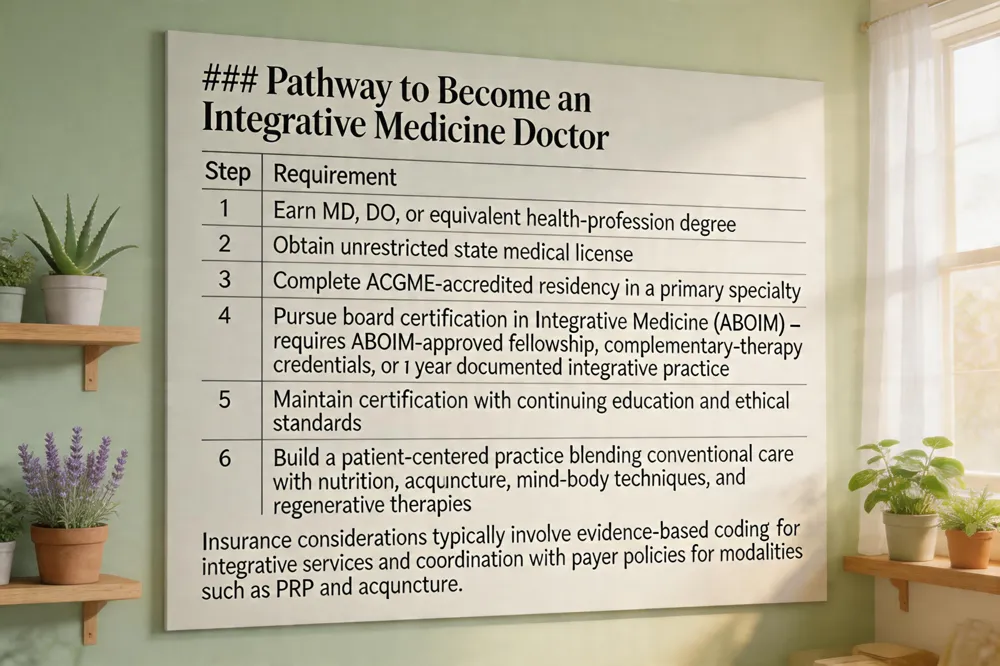
Pathway to Become an Integrative Medicine Doctor
| Step | Requirement |
|---|---|
| 1 | Earn MD, DO, or equivalent health‑profession degree |
| 2 | Obtain unrestricted state medical license |
| 3 | Complete ACGME‑accredited residency in a primary specialty |
| 4 | Pursue board certification in Integrative Medicine (ABOIM) – requires ABOIM‑approved fellowship, complementary‑therapy credentials, or 1 year documented integrative practice |
| 5 | Maintain certification with continuing education and ethical standards |
| 6 | Build a patient‑centered practice blending conventional care with nutrition, acupuncture, mind‑body techniques, and regenerative therapies |
Insurance considerations typically involve evidence‑based coding for integrative services and coordination with payer policies for modalities such as PRP and acupuncture.
 How to become an Integrative medicine doctor?
Earn an MD, DO, or equivalent health‑profession degree, obtain an unrestricted state license, and complete an ACGME‑accredited residency in a primary specialty. Pursue board certification in Integrative Medicine through the American Board of Integrated Medicine (ABOIM), which requires an ABOIM‑approved fellowship, qualifying complementary‑therapy credentials, or a year of documented integrative practice. Maintain certification with continuing education and ethical standards, then build a patient‑centered practice that blends conventional care with nutrition, acupuncture, mind‑body techniques, and regenerative therapies.
How to become an Integrative medicine doctor?
Earn an MD, DO, or equivalent health‑profession degree, obtain an unrestricted state license, and complete an ACGME‑accredited residency in a primary specialty. Pursue board certification in Integrative Medicine through the American Board of Integrated Medicine (ABOIM), which requires an ABOIM‑approved fellowship, qualifying complementary‑therapy credentials, or a year of documented integrative practice. Maintain certification with continuing education and ethical standards, then build a patient‑centered practice that blends conventional care with nutrition, acupuncture, mind‑body techniques, and regenerative therapies.
Functional Medicine and Regenerative Therapies
Functional Medicine Providers & Regenerative Modalities in LA
| Provider | Focus | Key Offerings |
|---|---|---|
| Dr. Anju Mathur (Angel Longevity Medical Center) | Anti‑aging, regenerative | Personalized nutrition, hormone balancing, gut‑health regimens |
| Dr. Julie Taylor (Telehealth) | Hormone replacement, microbiome | Hormone therapy, microbiome analysis, lifestyle coaching |
Four Regenerative Medicine Types
| Modality | Description |
|---|---|
| Viscosupplementation | Hyaluronic‑acid joint injections for lubrication and pain relief |
| Platelet‑Rich Plasma (PRP) | Autologous blood component injections to stimulate tissue repair |
| Stem‑cell‑based therapies | Use of adult or pluripotent stem cells for regeneration |
| Prolotherapy | Hypertonic‑dextrose‑induced inflammation to promote healing |
Pain‑management plans integrate these modalities with evaluation, non‑opioid interventions, physical therapy, and outcome monitoring.
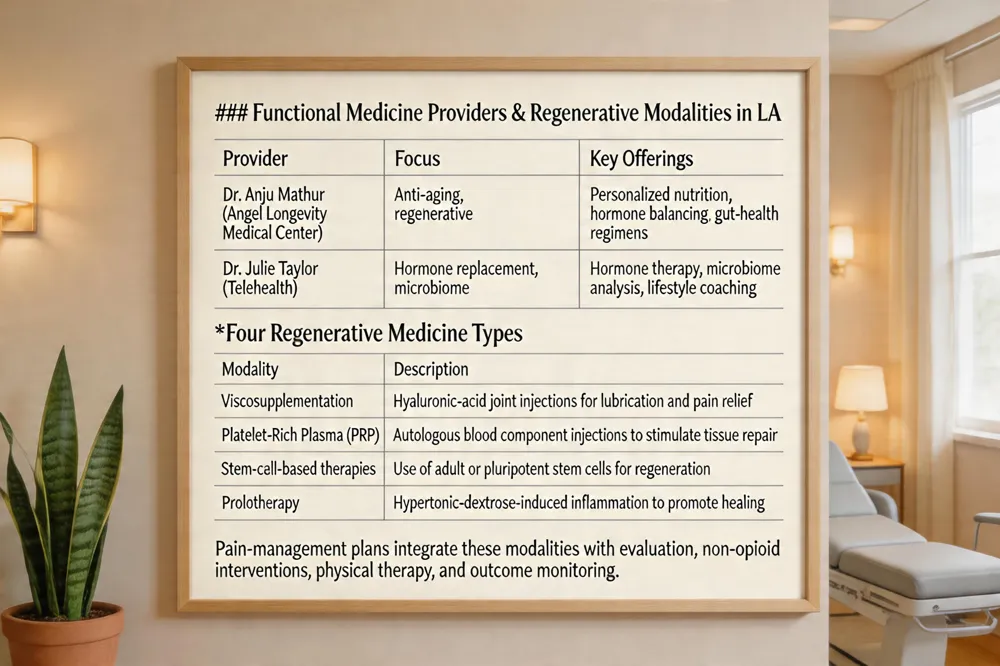 Functional medicine seeks the root causes of chronic illness rather than merely masking symptoms, using detailed labs, lifestyle reviews and gut‑health testing to design individualized protocols.
Functional medicine Los Angeles In Los Angeles, Dr. Anju Mathur at Angel Longevity Medical Center blends anti‑aging and regenerative approaches with personalized nutrition, hormone balancing and gut‑health regimens, while Dr. Julie Taylor offers a telehealth‑enabled program that integrates hormone replacement, microbiome analysis and lifestyle coaching. Both illustrate patient‑centered care that restores vitality.
What are the 4 types of regenerative medicine? The four primary modalities are viscosupplementation (hyaluronic‑acid joint injections), platelet‑rich plasma (PRP) injections, stem‑cell‑based therapies and prolotherapy (hypertonic‑dextrose‑induced inflammation).
Pain‑management plans combine a pain evaluation, non‑opioid interventions, PRP injections, physical‑therapy coordination and outcome monitoring, aligning treatment with each patient’s genetics, activity level and goals.
Future of Personalized Care – Data, AI, and Patient Empowerment
AI‑Driven Personalized Care Landscape
| AI/Application | Role in Care |
|---|---|
| Predictive analytics | Mine genomic, biomarker, and lifestyle data to forecast disease risk before symptoms appear |
| Decision‑support platforms | Provide clinicians real‑time recommendations for dosing (e.g., PRP) and therapy adjustments |
| Wearable sensors & digital health | Continuously track physiologic trends, feed data into AI models for dynamic care plans |
| Shared decision‑making tools | Present personalized risk/benefit analyses to empower patients |
| Outcome monitoring dashboards | Aggregate patient‑reported outcomes and clinical metrics for continuous improvement |
These technologies enable proactive, data‑rich, patient‑empowered care that shifts the focus from reactive treatment to wellness‑focused prevention.
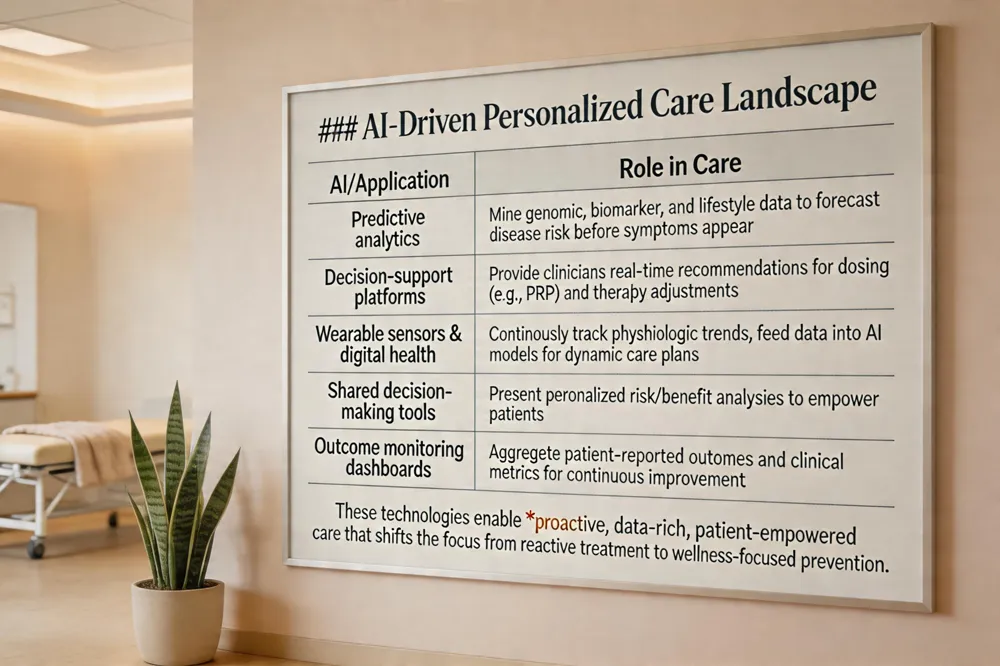 Predictive analytics and AI‑driven decision support will transform the 4P model of personalized health care by continuously mining genomic, biomarker and lifestyle data to forecast individual disease risk before symptoms appear. Integrated digital health platforms—secure electronic health records, wearable sensors, and AI‑based analytics—enable clinicians to track real‑time physiologic trends, adjust platelet‑rich plasma (PRP) dosing, and synchronize physical‑therapy or mind‑body interventions with each patient’s healing trajectory. By acting on the left side of disease inflection curve, providers can intervene early, reducing the need for invasive surgery and lowering long‑term costs. This data‑rich, patient‑empowered ecosystem supports shared decision‑making, aligns treatment with personal goals, and accelerates the shift from reactive to proactive, wellness‑focused care.
The Path Forward for Personalized, Non‑Surgical Pain Management
The next phase of pain care will weave regenerative tools—such as platelet‑rich plasma, stem‑cell‑derived orthobiologics, and biologic injections—with integrative therapies like acupuncture, nutrition counseling, and mind‑body techniques. By grounding each recommendation in a thorough patient assessment, clinicians can educate patients on the biology, realistic outcomes, and lifestyle factors that shape healing, fostering true shared decision‑making. As evidence mounts that these conservative, patient‑centered protocols lower opioid reliance and improve function, payers are beginning to reimburse regenerative procedures and digital‑health monitoring platforms. Tele‑medicine, wearable sensors, and AI‑driven analytics will enable real‑time outcome tracking, allowing insurers and providers to adopt value‑based models that expand access while maintaining safety and efficacy.