A New Era for Youthful Skin
Regenerative, non‑invasive aesthetics have surged as patients seek natural‑looking results without surgery. Techniques such as platelet‑rich plasma (PRP) therapy, microneedling (often paired with PRP or radiofrequency), and hyaluronic‑acid fillers now dominate U.S. aesthetic clinics, delivering collagen‑stimulating effects that last months to years while requiring minimal downtime. Modern neuromodulators like Botox® and Dysport™ relax dynamic wrinkles, and fractional laser or LED light therapies remodel skin texture without ablative injury.
Patients gravitate toward these conservative, patient‑centered options because they preserve facial mobility, limit recovery time, and carry low complication rates. The ability to customize protocols—combining volumizing fillers, skin‑tightening lasers, and growth‑factor serums—aligns with individualized treatment plans that respect each person’s anatomy and lifestyle.
Integrating skin science with everyday wellness further amplifies outcomes. Broad‑spectrum SPF, antioxidant‑rich diets, adequate hydration, and stress‑management support the regenerative pathways activated by in‑office procedures. When clinicians pair evidence‑based modalities with lifestyle counsel, the result is a sustainable, youthful glow that reflects both cutting‑edge technology and holistic health.
1. Platelet‑Rich Plasma (PRP) + Microneedling – The “Vampire Facial”
 Platelet‑Rich Plasma (PRP) therapy harvests a patient’s own blood, concentrates the platelets, and re‑injects them into the dermis where they release a cocktail of growth factors—including PDGF, TGF‑β, and VEGF—that stimulate fibroblast proliferation, collagen synthesis, and elastin remodeling. Microneedling, on the other hand, creates uniform micro‑injuries that trigger a wound‑healing cascade, recruiting inflammatory cells and up‑regulating matrix metalloproteinases that remodel the extracellular matrix. When PRP is applied immediately after microneedling, the micro‑channels act as highways for the growth factors, amplifying their penetration and prolonging their activity. This synergy translates into a markedly greater boost in collagen and elastin production than either modality alone. Clinical studies support this effect: a 2022 Journal of Cosmetic Dermatology trial reported a 30‑40 % increase in dermal collagen density and a 20‑30 % reduction in fine lines after a series of PRP‑enhanced microneedling sessions, with patients noting smoother texture and a radiant, youthful glow. The combined “vampire facial” thus leverages autologous biology and controlled mechanical stimulation to achieve non‑surgical skin rejuvenation with minimal downtime.
2. LED Light Therapy – Color‑Targeted Rejuvenation
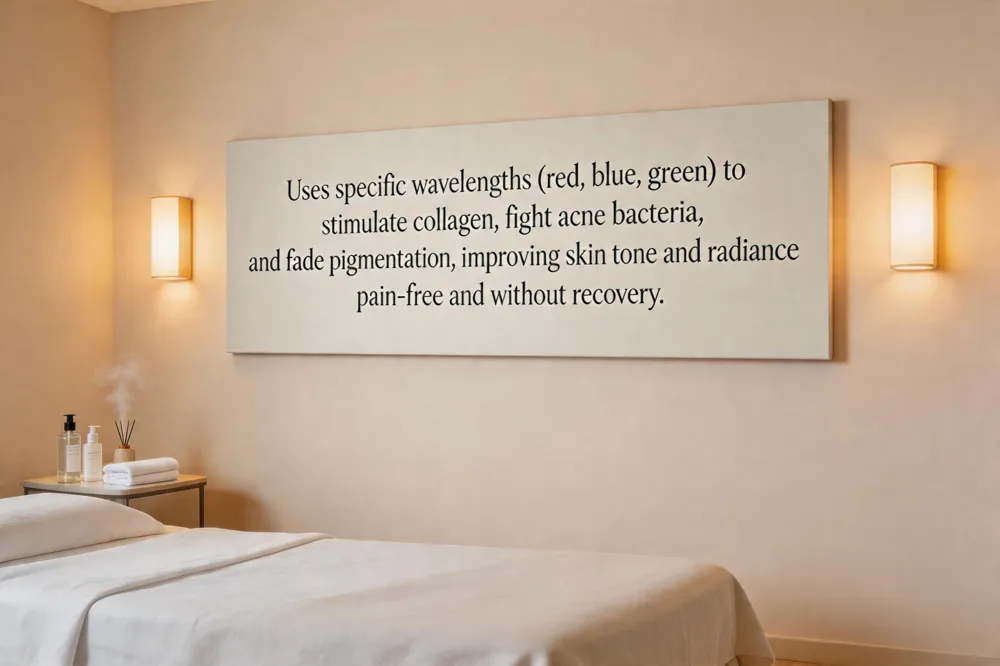 LED light therapy employs specific wavelengths—red for collagen synthesis, blue for acne bacteria, green for pigmentation—to improve skin texture without pain or downtime. Red light (typically 630‑660 nm) penetrates the dermis and stimulates fibroblast activity, boosting collagen synthesis and improving skin elasticity; clinical trials of low‑level red laser therapy have shown a 25 % increase in collagen I production after six weekly sessions. Blue light (around 415 nm) targets the bacteria Propionibacterium acnes, reducing breakouts and associated inflammation while also supporting a clearer complexion. Green light (≈530 nm) is absorbed by melanin and helps to disperse excess pigment, fading age spots and melasma without irritating the epidermis. Because LED devices heat only the superficial layers, sessions are entirely pain‑free and require zero downtime—patients can resume normal activities immediately. When incorporated into a personalized regimen that may also include hyaluronic‑acid serums, antioxidant moisturizers, and sunscreen, LED therapy enhances overall skin texture, tone, and radiance, delivering a youthful glow that builds gradually over a series of treatments.
3. Hydrafacial® – The 30‑Minute Glow Boost
 Hydrafacial® delivers a four‑step, in‑office facial—cleansing, exfoliation, extraction, and hydration—within just 30 minutes. The first two steps cleanse and gently exfoliate the epidermis with a patented vortex‑fusion tip, removing dead cells and debris while preparing the skin for deeper treatment. A suction‑enabled extraction phase clears clogged pores, reducing blackheads and minimizing the risk of post‑procedure breakouts. The final step infuses customized serums directly into the dermis; clinicians can select hyaluronic acid for instant plump,, C for antioxidant protection, and peptide blends to stimulate collagen synthesis. This combination produces immediate radiance, reinforces the skin barrier, and improves texture without visible redness or downtime. Because the procedure uses non‑abrasive, low‑energy technology, it is safe for all skin types—including sensitive, oily, and mature skin—and carries a minimal adverse‑event profile limited to temporary mild redness. The result is a luminous, hydrated complexion that lasts for days, making Hydrafacial® a cornerstone of non‑surgical rejuvenation protocols that prioritize quick recovery and consistent, visible results.
4. Laser Skin Rejuvenation – From BBL to Fractional CO₂
 BroadBand Light (BBL) photo‑facials are a non‑ablative light‑based option that targets sun‑induced damage and age spots. By delivering high‑intensity pulses of filtered light, BBL selectively breaks down melanin and hemoglobin, prompting the skin’s natural healing response and stimulating new collagen formation. Results appear within a week, and most patients experience only mild redness that resolves in under 24 hours.
Fractional laser technologies fall into two categories: non‑ablative and ablative. Non‑ablative fractional lasers (e.g., 1550 nm Er:YAG) create microscopic columns of thermal injury in the dermis while leaving the epidermis intact. This approach triggers collagen remodeling with minimal downtime—typically less than a day of low‑grade swelling and redness. Ablative fractional CO₂ lasers in contrast, vaporize microscopic portions of the epidermis and deeper dermal tissue, producing more aggressive collagen denaturation and rapid resurfacing. While ablative treatments yield greater improvements in texture and deep wrinkles, they require a recovery period of several days to a week due to crusting and erythema.
Both modalities enhance pigment irregularities and overall skin tone by encouraging the turnover of melanized cells and promoting uniform collagen deposition. The choice between non‑ablative and ablative fractional lasers hinges on the patient’s desired speed of improvement, tolerance for downtime, and specific skin concerns.
5. Radiofrequency Microneedling (Morpheus8) – Deep Dermal Tightening
 Morpheus8 merges fractional microneedling with radiofrequency (RF) energy, creating a dual‑action protocol that penetrates deep into the dermis. The microneedle channels provide a controlled pathway for RF heat, delivering temperature‑controlled thermal injury to the underlying connective tissue while preserving the epidermal surface. This synergy triggers a robust wound‑healing cascade, markedly up‑regulating neocollagenesis and elastin synthesis. Clinical studies report that patients experience an average 1.5‑point improvement on the Global Aesthetic Improvement Scale (GAIS) after just six weeks, reflecting visible tightening and texture enhancement. Because the treatment targets both the superficial micro‑injuries and the deeper dermal layers, it is particularly effective for smoothing fine lines, reducing mild to moderate laxity, and softening superficial scar tissue. Recovery is minimal—most individuals resume normal activities within 24‑48 hours, with only transient erythema and mild swelling. The result is a firmer, more radiant complexion that looks natural and youthful, making Morpheus8 a cornerstone of modern, non‑surgical facial rejuvenation protocols.
6. Exosome & Polynucleotide Injections – Next‑Gen Regeneration
 Exosome and polynucleotide (PN) injections represent the cutting edge of non‑surgical skin rejuvenation. Exosomes are extracellular vesicles that ferry micro‑RNAs, proteins, and lipids directly into dermal fibroblasts, re‑programming cellular pathways to boost collagen‑elastin synthesis and modulate inflammation. In parallel, DNA‑derived polynucleotides act as a hydrating scaffold, attracting water molecules and providing a biodegradable matrix that supports sustained growth‑factor activity within the skin.
Early‑phase clinical trials have reported a measurable 15‑20 % increase in skin firmness after a series of four weekly exosome‑PN sessions, with patients noting smoother texture and a visible lift of fine lines. These regenerative effects are amplified when the injections are sequenced after laser resurfacing or microneedling; the micro‑channels created by those modalities allow deeper exosome penetration and more uniform PN distribution, accelerating collagen remodeling and shortening recovery time.
Because both exosomes and polynucleotides are autologous or synthetically produced to mimic natural biological signals, they carry a low risk of adverse reactions while delivering a synergistic boost to traditional rejuvenation protocols. As research progresses, they are poised to become a standard adjunct in comprehensive, non‑invasive anti‑aging regimens.
7. Injectable Hyaluronic‑Acid Fillers – Volume & Hydration
 Hyaluronic‑acid (HA) fillers restore lost facial volume and smooth deep lines by physically augmenting the dermis and providing internal hydration. Modern HA gels are cross‑linked to mimic the skin’s natural viscoelasticity, allowing them to lift cheeks, lips, and under‑eye areas with an immediate plumping effect that typically endures for 6 to 18 months, depending on product formulation and treatment area. Because the filler is composed of a naturally occurring polysaccharide, it can be safely dissolved with hyaluronidase if over‑correction or adverse reactions occur, offering an added layer of patient safety. Clinical experience shows that HA fillers not only add volume but also attract water molecules, improving skin turgor and radiance. When combined with other non‑surgical modalities—such as PRP, microneedling or laser resurfacing—HA fillers contribute to a holistic rejuvenation protocol that addresses both surface texture and deeper structural support, delivering a youthful glow without surgery.
Putting It All Together – A Personalized, Non‑Surgical Path to Radiance
Combination protocols amplify results because each modality addresses a different layer of the aging process. For example, pairing platelet‑rich plasma (PRP) with laser resurfacing delivers growth‑factor‑rich plasma that accelerates collagen remodeling while the laser creates micro‑thermal zones for new tissue formation, yielding up to 30 % greater improvement in texture and pigmentation than either treatment alone (American Society of Dermatologic Surgery, 2023).
An integrative assessment goes beyond the skin surface. By evaluating diet, sleep, stress, hormonal balance, and gut health, clinicians can pinpoint systemic contributors to premature aging and tailor nutritional or lifestyle interventions—such as antioxidant‑rich foods, adequate hydration, and UV‑protective habits—that synergize with in‑office procedures.
A conservative, patient‑centered approach prioritizes natural‑looking outcomes, minimal downtime, and safety. Starting with low‑risk modalities (e.g., LED light therapy, gentle chemical peels) and progressively layering more intensive options (e.g., RF microneedling, hyaluronic‑acid fillers) allows the skin’s own regenerative pathways to adapt, producing a lasting, radiant glow without the risks of surgery.