
A Framework for Repair
Bioengineered scaffolds are three-dimensional materials designed to give cells a supportive place to attach, grow, and organize. Researchers build them to reproduce selected features of the extracellular matrix, or ECM, the network of proteins and other molecules that surrounds cells in the body. A scaffold is a framework for tissue development, not regenerated tissue itself. Reviews of tissue-engineering scaffolds describe how these materials can be combined with cells and biochemical signals in research.
Depending on its material and design, a scaffold may provide a surface for cell attachment, space for cells to move, and interconnected pores that allow nutrients to enter and waste products to leave. It can also present physical or chemical cues that affect cell behavior. These functions are intended to support tissue formation, but they do not guarantee that new tissue will form or work as intended. The appropriate design depends on the target tissue and its mechanical and biological demands.
The research spans different materials and applications, from hydrogel systems studied in laboratories to engineered frameworks investigated for tissue repair. Findings from laboratory models or animal studies can help researchers test how cells respond to a material, but they do not establish that a scaffold is an effective treatment for a particular person. Evidence must be considered for the specific condition, product, and clinical use.
That distinction matters for people weighing care for pain or injury. Scaffold research should not be presented as proof of a non-surgical alternative to surgery or as an established treatment for back pain, sports injuries, or carpal tunnel syndrome. Advanced Integrative Medicine describes a conservative, patient-centered approach to pain management, including platelet-rich plasma therapy; that clinical service is distinct from the scaffold research discussed here.
The reviews cited in this article examine biomaterials, tissue engineering, and regenerative-medicine research. They do not evaluate platelet-rich plasma, Dr. Jaimal Sangha, or the effectiveness of treatments offered by Advanced Integrative Medicine. The following sections therefore focus on what scaffolds are designed to do, where researchers are studying them, and what remains uncertain, without implying that experimental findings establish a clinical benefit.
What Scaffolds Do
 Tissue engineering combines cells, materials, and biochemical or physical signals to support, maintain, improve, or replace tissue. A scaffold is the material framework in that approach. It can give cells a place to attach and move through, while offering cues that influence how they grow and develop. The aim is to reproduce useful parts of the environment around cells, not to create a complete copy of living tissue.
A scaffold may be used to hold cells at a target site or carry bioactive factors, such as molecules that affect cell activity. Its structure can also help cells organize as new tissue forms. Some scaffolds provide temporary support and are designed to break down over time, allowing developing tissue to take on more of the work. For that transition to work as intended, material breakdown needs to be compatible with the pace of tissue formation. These are design goals, not guaranteed results for a particular injury or patient. Scaffold functions and design approaches are being studied across different tissues.
The design depends on where a scaffold will be used and what that tissue needs to do. Interconnected pores can help nutrients reach cells and waste products leave. The material also needs to be compatible with cells and surrounding tissue, maintain a useful shape, and provide suitable mechanical support. A soft, flexible framework may suit one application but may not withstand the forces placed on a load-bearing tissue. Researchers also consider how cells will attach, migrate, and respond to the scaffold’s physical and biological cues.
The extracellular matrix, or ECM, is the network of molecules around cells that supports tissue structure and influences cell behavior. Scaffolds can reproduce selected ECM features, such as a porous structure, mechanical cues, or sites for cell attachment. But the ECM is part of a changing environment that also includes neighboring cells, chemical signals, and local conditions. Reproducing that full complexity remains difficult, so a scaffold’s properties alone cannot ensure that tissue will form or function as intended. Research on engineered scaffold environments describes these materials as tools for guiding and studying cell behavior, not as proof of a treatment’s clinical effectiveness.
This distinction matters when discussing patient care. Advanced Integrative Medicine describes a conservative, patient-centered approach to pain management that includes platelet-rich plasma therapy. That is different from tissue-engineering research on scaffolds: the available scaffold reviews do not establish that scaffold-based treatments are effective for back pain, sports injuries, or carpal tunnel syndrome. A material’s ability to support cells in a laboratory or engineered construct should not be presented as evidence that it can repair a specific condition in a patient.
Materials and Design Choices
A scaffold’s material and structure help determine how cells interact with it. Naturally derived materials such as collagen, fibrin, alginate, chitosan, gelatin, silk fibroin, and hyaluronic acid can provide cues that support cell attachment and survival. Their biological familiarity can be useful, but their mechanical and chemical properties may be harder to adjust independently.
Synthetic materials, including polyethylene glycol (PEG), polylactic acid (PLA), polyglycolic acid (PGA), and polycaprolactone (PCL), give researchers more control over features such as stiffness and the rate at which a material breaks down. They may need surface or chemical modifications to help cells attach and grow. Neither category is automatically suitable for every tissue: selection depends on the intended role and the environment where the scaffold would be used. Reviews of scaffold materials and design approaches emphasize that these properties must be considered together.
Hydrogels and cell responses
Hydrogels are water-rich networks formed by linking polymer chains together. Their water content and soft structure make them useful for three-dimensional cell culture, where researchers can study cells in surroundings that differ from a flat laboratory dish. Some formulations can be mixed with cells while liquid and then gelled at a target site. This offers a way to shape a cell-containing material around an irregular space, though injectable handling does not establish that a hydrogel will improve a patient’s outcome.
Researchers can adjust a hydrogel’s stiffness, elasticity, and viscoelasticity, or the way it deforms and recovers over time. These mechanical cues can affect cell shape and behavior in laboratory studies. Surface patterns and adhesion peptides can influence how cells attach, while growth-factor-binding features may help hold biological signals near cells. Other designs include links that cells can break down as they move through or remodel the material. These are ways to investigate and guide cell behavior, not guarantees of a particular tissue response. Research on tailoring hydrogels for stem-cell environments describes these design options and the challenges of translating them into dependable clinical approaches.
Fabrication methods also shape a scaffold’s properties. Electrospinning forms networks of fine fibers, while freeze-drying, solvent casting, and gas foaming can produce different pore structures. Computer-aided design and manufacturing can help control a scaffold’s shape and pore arrangement; bioprinting can place materials and, in some experimental systems, cells in a planned pattern. The choice of method affects how consistently a scaffold can be made and how its pores, thickness, and mechanics can be controlled.
For readers considering care, these material-design studies should be kept distinct from treatments offered for specific conditions. Advanced Integrative Medicine describes a conservative, patient-centered approach to pain management, including platelet-rich plasma therapy; the scaffold research discussed here does not establish that scaffolds treat back pain, sports injuries, or carpal tunnel. Material properties remain research questions, while clinical decisions depend on evidence for the particular treatment and condition.
Potential Benefits and Applications
What are the benefits and applications of regenerative medicine?
Scaffold research explores ways to give cells a supportive setting in which to survive, organize, respond to signals, and contribute to tissue formation. Depending on the material and design, a scaffold may provide a temporary structure, help retain cells or biological signals near a target area, or create conditions that encourage cells to attach and move. These are potential engineering benefits, not promises of tissue regeneration or specific results for an individual patient.
Researchers are studying scaffolds across several areas, including skin and wound repair, bone and cartilage engineering, vascular grafts, and neural tissue. In some approaches, a scaffold carries cells; in others, it is designed to hold or release therapeutic molecules, or to encourage the body’s own cells to move into an injured area. Each application has different biological and mechanical demands, so evidence from one tissue cannot establish that the same approach will work elsewhere. A review of engineered hydrogel systems describes these varied research directions while emphasizing the challenges of translating them into reliable treatments for patients.
Wound repair offers a useful example of how a scaffold might work. Its porous structure can provide space for cells to migrate and help exchange nutrients and cellular waste. Researchers are also testing materials that carry cells or bioactive signals intended to influence processes involved in healing. A review of scaffold research in skin repair describes these strategies, but it also notes continuing challenges such as infection, blood-vessel formation, and maintaining cell viability. Findings from wound research should not be treated as evidence for other conditions, including musculoskeletal pain or nerve-related symptoms.
Some tissue-engineered skin products are used in wound care, and scaffold-based cartilage approaches have been reported in clinical settings. These examples show that certain engineered tissues have moved beyond laboratory research. They do not show that every scaffold design is effective, suitable for every patient, or able to restore every kind of damaged tissue. The material, cells, manufacturing process, intended use, and available clinical evidence all matter.
For people seeking pain care, those distinctions are especially relevant. The reviewed sources do not establish bioengineered scaffolds as effective treatments for back pain, sports injuries, or carpal tunnel syndrome, and they do not show that scaffolds are proven substitutes for surgery. Advanced Integrative Medicine describes a conservative, patient-centered approach to pain management, including platelet-rich plasma therapy for selected conditions. That practice information does not establish a clinical link between PRP and scaffold research.
The supplied scaffold reviews do not evaluate PRP or show that its effects can be inferred from scaffold studies. PRP and bioengineered scaffolds are distinct approaches, and evidence about one does not demonstrate the benefits of the other. For a patient, the practical question is whether a proposed treatment has evidence for the specific condition, along with a clear discussion of its uncertainties and alternatives.
Scaffolds therefore offer a broad research platform for studying how materials, cells, and signals may support repair. Their applications range from wound-care materials to experimental work on bone, cartilage, blood vessels, and neural tissue. The promise is application-dependent: laboratory or animal findings, and the use of particular engineered products, do not by themselves establish that a scaffold will improve a given patient’s symptoms or replace established care.
Stem Cells and Evidence Boundaries
Stem cells can make copies of themselves and develop into specialized cell types. Researchers are studying whether scaffolds can provide a better setting for these cells, since transplanted cells may not survive or remain at the target site, integrate successfully, or develop in a controlled way. These are research goals, not established results for every scaffold or condition. A recent review of biomaterials describes how scaffold properties may influence cell survival, retention, and differentiation, while emphasizing the challenges of translating such approaches into reliable treatments (review of engineered biomaterials in stem-cell research).
What can stem cell treatments currently treat, and what does the evidence show?
The scaffold reviews considered here do not establish which stem-cell treatments are currently approved, and they do not provide a full assessment of established treatments such as blood-forming stem-cell transplantation. The 2024 review notes that clinical success for stem-cell-based treatments remains limited outside established uses, but it is not a comprehensive guide to approved therapies or indications (review of engineered biomaterials in stem-cell research.
That distinction matters for patients. Laboratory experiments and animal studies can help researchers test whether a material supports cells, but they cannot by themselves show that an injection is safe and effective in people. Studies of hydrogel delivery, spinal-cord injury models, or experimental bone and cartilage formation should not be treated as proof that scaffold-assisted stem cells regenerate tissue in routine care. A review of hydrogel scaffolds, for example, describes these systems as research platforms and notes persistent barriers to controlling cell behavior and bringing therapies into clinical use (review of bioengineered scaffolds for stem cells).
The same evidence boundary applies to claims about stem-cell injections for back pain, arthritis, sports injuries, carpal tunnel, Parkinson’s disease, or other named conditions. The sources supplied for this section do not establish that these injections treat those conditions. They also do not provide condition-specific recommendations, comparisons with standard care, or long-term safety evidence for such uses.
At Advanced Integrative Medicine, Dr. Jaimal Sangha’s practice takes a conservative, patient-centered approach to pain care and offers platelet-rich plasma therapy. That service is distinct from scaffold-assisted stem-cell research; the reviews discussed here do not assess PRP or establish the effectiveness of either approach for a particular patient.
How researchers test scaffold-assisted approaches
Three-dimensional culture systems give researchers ways to study cells in an environment that can represent some features of living tissue more closely than conventional flat cultures. High-throughput hydrogel arrays extend this work by allowing investigators to compare different combinations of stiffness, degradability, and biological signals. These methods help identify factors that affect cell maintenance or differentiation, but they are laboratory tools, not treatments offered to patients.
Researchers use these platforms to ask focused questions: which material properties support cell survival, which signals affect cell development, and whether cells respond consistently when conditions change. Answers can guide future experiments, but they do not establish that a particular product will work in a human body. The review on tailoring scaffolds for stem cells describes adjustable hydrogels and microarrays as ways to study cell behavior, while identifying reproducibility and clinical translation as ongoing challenges (review of scaffold design for stem-cell research.
For anyone considering a stem-cell procedure, ask what condition the treatment is intended to address, what human evidence supports that use, and what risks and regulatory status apply. Discuss the options with a qualified clinician, and distinguish a properly overseen clinical trial from a treatment presented as established care. Evidence for a material in a dish or an animal model is an early research step, not a guarantee of benefit.
Matching Scaffolds to Tissue
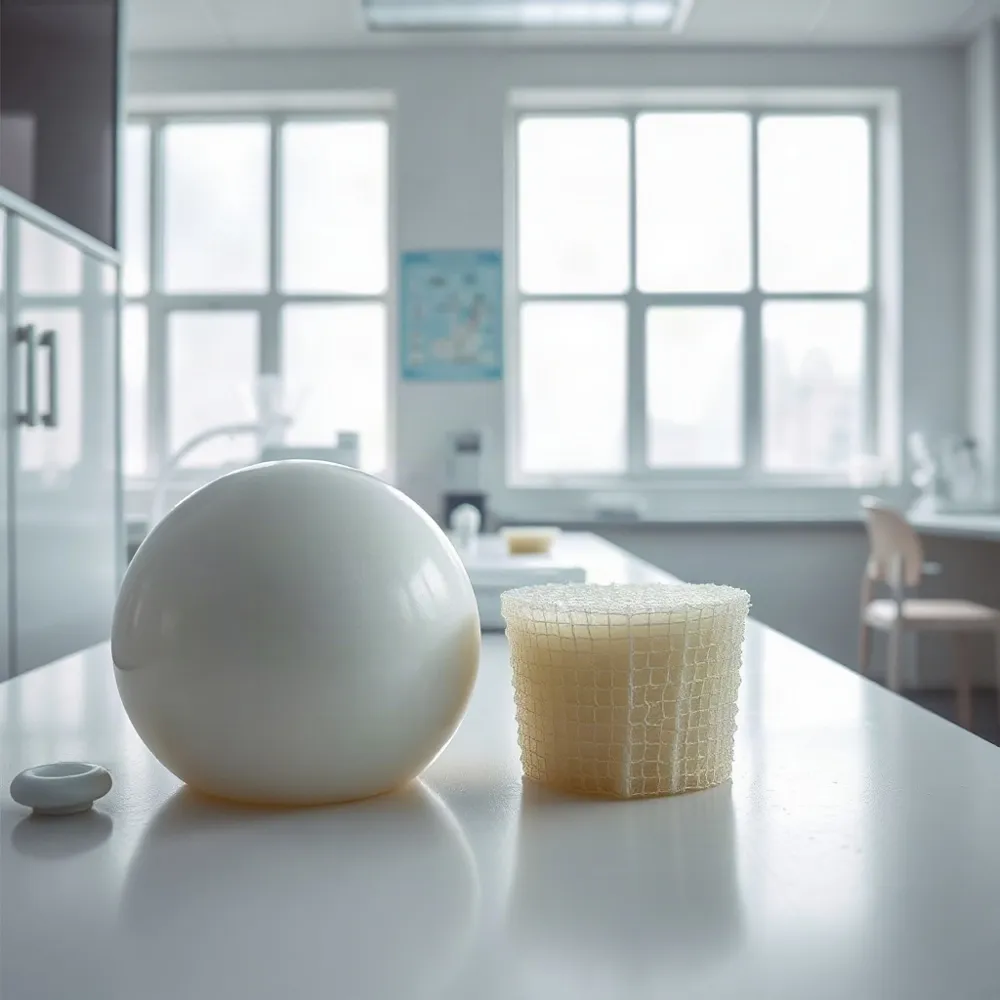 A scaffold that supports one tissue may not suit another. Design choices depend on the tissue’s normal job, the location and extent of damage, and the forces the repair must withstand. A soft, hydrated material may help researchers model or support soft tissue, while a structure intended for a load-bearing site needs different mechanical properties. This is why scaffold research does not point to one material as a general solution for every injury.
Hydrogels illustrate the tradeoff. Their water-rich structure can provide a cell-friendly setting, but a review reports a mechanical-modulus range of about 0.1–100 kPa for the hydrogels it discusses. That range is generally too low for a hydrogel to immediately replace bone’s load-bearing role. The same review describes hydrogel scaffolds as more suited to soft-tissue research, while emphasizing that suitability depends on the specific material and application (review of hydrogel scaffolds.
The intervertebral disc shows why matching a scaffold to the target tissue can be especially difficult. The disc has distinct regions with different mechanical and hydration properties, so an approach for early degeneration may not address the structural loss and loading demands of more advanced damage. A review of disc-engineering strategies describes options ranging from injectable cell carriers to cell-seeded scaffolds and decellularized tissue matrices, while noting that no single design addresses every stage (review of scaffold approaches for disc regeneration).
For early degeneration, researchers have explored materials intended to keep cells at the site and support production of extracellular matrix, including proteoglycans that help the disc’s central region retain water. A delivery material that is too weak or fluid, however, may leak or be forced out of the disc. As degeneration advances, a scaffold may need to compensate for greater matrix loss and withstand more demanding loads. Researchers then face the combined task of supporting cells, preserving cell viability, and improving mechanical stability without harming the cells.
Late-stage repair poses further demands: an implant may need to help restore disc height and hydration, support long-term matrix remodeling, and join securely with neighboring tissue regions that differ in structure and mechanics. In one ex vivo study using bovine discs, a collagen-based nucleus replacement restored disc height but extruded after a few loading cycles. That result highlights a design problem, not a treatment recommendation or evidence of benefit for people with back pain.
These constraints matter when interpreting claims about regenerative care. At Advanced Integrative Medicine, Dr. Jaimal Sangha’s practice takes a conservative, patient-centered approach and offers platelet-rich plasma therapy for pain conditions; the cited scaffold research does not evaluate PRP or establish scaffold treatment as an alternative for back pain. Laboratory and animal findings can guide future design, but they do not show that a scaffold will work for a particular patient or condition.
Vascularization and Cell Survival
A scaffold can provide cells with a place to attach, but that alone does not ensure they will stay alive or function after implantation. Cells need oxygen and nutrients, and many engineered constructs are limited to a few hundred microns in thickness when relying on diffusion alone. Beyond that scale, cells farther from a blood supply may not receive what they need.
Researchers are testing ways to improve transport and encourage blood-vessel growth. One approach is to coculture mesenchymal stem cells with endothelial cells, which help form the lining of blood vessels. Other designs build small channels into a scaffold or use microfluidic systems to move fluid through larger constructs in the laboratory. These methods can help researchers study cell survival under conditions that better resemble tissue, but they do not yet solve the challenge of joining engineered channels to a patient’s circulation. A review of hydrogel scaffolds describes these strategies and the limits on translating them into clinical use (scaffold vascularization research.
Vascular access is only part of the problem. After implantation, cells must also retain an appropriate identity and carry out useful functions within a changing environment. A decellularized matrix may preserve some features of the original tissue, but repopulating it evenly and supporting the introduced cells remain technical challenges. Scaffold properties, cell type, tissue thickness, immune responses, and the pace of degradation can all affect whether a construct integrates or loses function.
Wound research illustrates both the potential and the evidence limits. A UC Davis team reported improved blood-vessel formation and healing measures with an engineered collagen scaffold containing endothelial cells in a mouse model of deep burns. That result is specific to an animal study, not proof of benefit in people or in other tissues (UC Davis scaffold study). Vascularization strategies are being explored across tissue engineering, but including channels or vessel-supporting cells in a design does not show that it will connect successfully, persist, or improve a patient’s outcome.
For people considering care for pain, it helps to distinguish this research from available clinical services. Advanced Integrative Medicine, led by Dr. Jaimal Sangha, offers platelet-rich plasma therapy as part of a conservative approach to conditions such as back pain and sports injuries. That treatment is distinct from cell-seeded scaffold research, and findings about engineered blood vessels do not establish the effectiveness of either approach for a particular person. A clinician can discuss the evidence and options relevant to an individual condition without treating laboratory progress as a clinical result.
Safety and Clinical Translation
 What is the biggest challenge facing regenerative medicine? The supplied reviews point to translation: turning promising laboratory and animal research into treatments that are safe, reproducible, and effective in people. A scaffold may support cells under controlled research conditions, but that does not show it will work predictably in a patient or for a particular condition. A review of stem-cell scaffold research describes persistent difficulties in controlling cell behavior and developing functional tissue constructs.
The challenge is not simply making a material that holds its shape. Researchers need to understand how cells respond to a scaffold’s physical and biochemical cues, and to control whether stem cells survive, multiply, or develop into the intended cell types. A scaffold must also be compatible with surrounding tissue, integrate appropriately, and degrade at a pace that does not undermine repair. If it is meant to bear load, its mechanical performance must remain suitable as tissue forms and conditions change.
Those demands vary with the target tissue. A soft, injectable hydrogel may suit some research applications but may not provide the strength needed for a load-bearing structure. Cell-containing constructs also need adequate oxygen and nutrient delivery, and vascularization remains difficult to achieve reliably. These are connected design and safety questions: a material’s performance in a dish cannot by itself establish how it will behave after implantation.
Controlling materials and cells
Scaffold manufacturing must produce materials with consistent composition, structure, and performance from one batch to the next. Complex designs that combine cells, biological signals, and precisely organized pores may be difficult to make at scale. Production costs, quality controls, and regulatory approval also affect whether a promising research method can become a clinical product. These requirements do not guarantee success, but they help determine whether results can be repeated and whether safety can be assessed.
How a scaffold is formed can introduce additional concerns. Light-triggered cross-linking can be useful for shaping some hydrogels, but ultraviolet exposure and photoinitiators may harm sensitive cells if conditions are not carefully controlled. Enzyme-mediated methods may form materials under gentler conditions, but reagent concentrations and any remaining substances still need evaluation. The review discusses these approaches as engineering methods, not as evidence that a particular formulation is safe or effective for patients.
Decellularized scaffolds present a different balancing act. Processing must remove enough cellular material to reduce the chance of an unwanted immune response while preserving useful extracellular-matrix structure and function. If removal is incomplete, residual antigens may remain; if processing is too harsh, important proteins, growth factors, or mechanical properties may be damaged. Sterilization is also necessary, yet some methods can alter scaffold structure or leave residues, so the final material requires testing.
What evidence can patients rely on?
Evidence should be judged by the specific material, cells, tissue, and condition studied. Findings from cell cultures or animal models can help researchers identify risks and refine a design, but they do not establish clinical benefit in people. Even promising early results need confirmation through well-designed human studies, with follow-up that can assess safety and whether benefits last. Reviews of scaffold design and clinical translation emphasize that engineering potential and demonstrated treatment outcomes are not interchangeable.
For patients considering care for pain or an injury, a practical conversation should focus on evidence for the specific diagnosis, expected benefits, known risks, and available alternatives. Advanced Integrative Medicine describes a conservative, patient-centered approach to pain management, including platelet-rich plasma therapy; however, the supplied scaffold reviews do not evaluate that therapy or establish that scaffolds treat back pain, sports injuries, or carpal tunnel syndrome. Those topics should be assessed using condition-specific clinical evidence rather than inferred from general tissue-engineering research.
The supplied sources do not quantify comparative outcomes, insurance coverage, or the relative safety and efficacy of specific pain treatments. They therefore cannot support claims that a scaffold is safer or more effective than another option, or that it replaces surgery. Patients should discuss their own circumstances, uncertainties, and treatment alternatives with a qualified clinician.
Promise Requires Proof
Bioengineered scaffolds offer researchers adaptable platforms for studying how cells attach, survive, organize, and respond to physical and biological cues. Their purpose is to support tissue formation, not to guarantee that damaged tissue will regenerate. Reviews of scaffold research describe many possible designs, while emphasizing the challenges of controlling cell behavior and translating laboratory approaches into reliable care (scaffold design for stem-cell research).
What a scaffold can do depends on its material, architecture, the cells it carries or encounters, the target tissue, and the clinical setting. A structure suited to soft tissue may not provide the strength needed for a load-bearing site. Larger constructs also need an adequate blood supply, and researchers must address safety, consistent manufacturing, cost, and regulatory requirements before a promising design can become a dependable treatment. These are distinct challenges, not details that a scaffold’s intended function can resolve on its own.
This distinction matters when considering care for pain. Research on scaffolds does not establish that they are a proven treatment for back pain, sports injuries, or carpal tunnel syndrome, or that they can replace surgery. At Advanced Integrative Medicine, Dr. Jaimal Sangha’s practice takes a conservative, patient-centered approach to pain management, including platelet-rich plasma therapy; that service should not be confused with scaffold-based treatment, which the cited research does not evaluate.
Anyone considering a regenerative procedure can ask a qualified clinician what evidence supports its use for their specific condition, what the proposed intervention involves, and what risks and alternatives apply. Ask whether the approach is part of properly overseen research, and how its results will be assessed. Clear answers help separate a research possibility from an established treatment and support informed decisions about care.