Why a Structured, Non‑Surgical Approach Matters
The rotator cuff consists of four muscles—supraspinatus, infraspinatus, teres minor, subscapularis—that originate on the scapula and insert on the humerus, providing dynamic stability for the glenohumeral joint. Its tendons receive a limited blood supply, especially in the “critical zone” of the supraspinatus, which slows natural repair and makes factors such as age, smoking, and diabetes detrimental to healing. Biologic recovery proceeds through four overlapping phases: inflammation (0‑7 days) where pain and swelling are managed; early healing (1‑6 weeks) marked by collagen synthesis and scar formation; remodeling (6 weeks‑3 months) during which collagen fibers realign under gentle load; and maturation (3‑12 months) when tensile strength approaches normal. A patient‑centered regenerative approach integrates these timelines with individualized care—rest, anti‑inflammatory diet, PRP injections, and progressive physical‑therapy—allowing the body’s own biology to heal while respecting each patient’s goals, comorbidities, and activity level. Regular reassessment using validated outcome measures ensures progression aligns with the healing phase and patient expectations.
Understanding the Biology of Rotator Cuff Healing
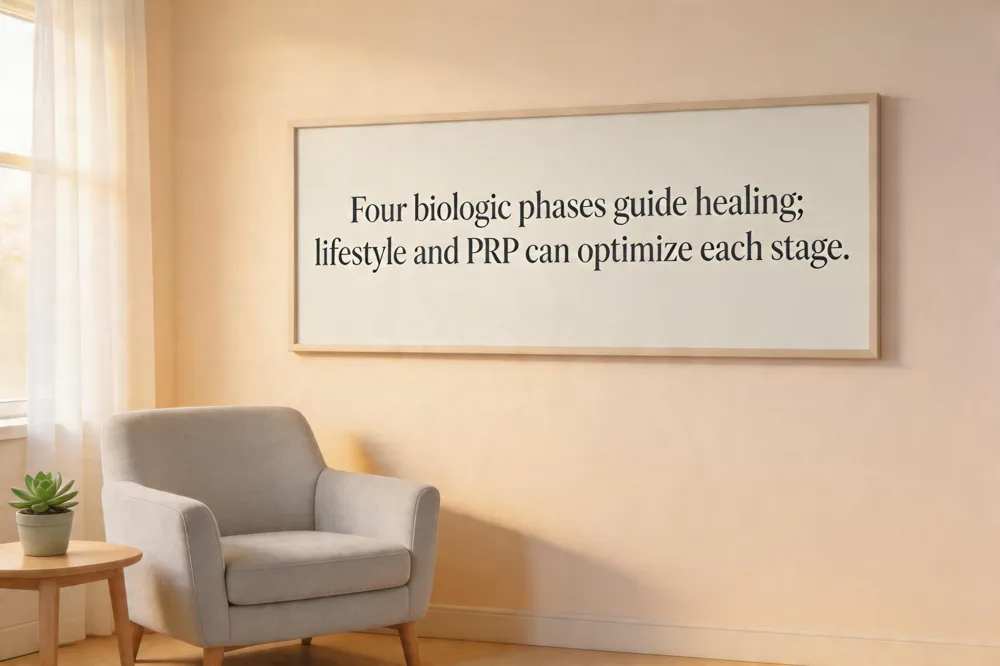 Recovery follows four biologic phases. Inflammation (0‑7 days) is the acute stage; pain, swelling, and inflammatory mediators dominate, and the goal is pain control with rest, ice, and anti‑inflammatory medication. Early healing (1‑6 weeks) is characterized by proliferative activity in the tendon’s “critical zone,” a region of naturally poor blood supply. Passive range‑of‑motion (PROM) exercises protect the repair while allowing synovial fluid circulation. Remodeling (6 weeks‑3 months) sees collagen fibers reorganize, and gradual active and light‑resistance exercises are introduced to promote proper alignment and tensile strength. Maturation (3‑12+ months) involves long‑term collagen cross‑linking, scar tissue remodeling, and progressive functional loading; full strength may not be restored until a year post‑injury. Age, smoking, and diabetes further impair each phase by reducing vascularity, limiting fibroblast activity, and increasing catabolic cytokines. Consequently, lifestyle modifications—quitting smoking, managing glucose, and adopting an anti‑inflammatory diet—are essential. Regenerative adjuncts such as platelet‑rich plasma (PRP) can supply concentrated growth factors, potentially accelerating collagen synthesis and mitigating the negative impact of these risk factors, thereby supporting a smoother transition through the four healing phases.
Core Non‑Surgical Strategies
 The most effective non‑surgical approach for a torn rotator cuff combines several evidence‑based elements. First, protect the tendon with rest, activity modification, and ice for the initial 1‑2 weeks to control inflammation and swelling. Short‑term NSAIDs (e.g., ibuprofen) can be used for pain relief, but should be limited to avoid blunting the natural healing cascade. A structured physical‑therapy progression follows a four‑phase timeline: (1) passive range‑of‑motion (pendulum swings, wall slides) and scapular mobilizations ( weeks‑2 weeks); (2) active‑assisted motion and light resistance (2‑6 weeks); (3) active motion with light band work (6‑12 weeks); and (4) progressive strengthening and functional drills (12‑24 weeks). Throughout, reinforce anti‑inflammatory nutrition—high‑quality protein, omega‑3 fatty acids, vitamin C‑rich fruits/vegetables—and ensure adequate hydration, 7–9 hours of sleep, and smoking cessation to optimize tendon collagen synthesis. Adding a single platelet‑rich plasma (PRP) injection early in the protocol can further reduce inflammation and deliver growth factors that promote tendon healing.
What is the best non‑surgical treatment for a torn rotator cuff? A multimodal regimen of rest, ice, brief NSAID use, progressive PT, and lifestyle optimization, with PRP as an adjunct, provides the most reliable conservative care.
How do I repair my rotator cuff naturally? Begin with a low‑impact warm‑up, then alternate flexibility work (pendulum, wall‑angel, cross‑body stretches) and strength exercises (elastic‑band external/internal rotation, scaption lifts, scapular squeezes) 2‑3 times weekly, progressing only when pain‑free, while supporting healing with anti‑inflammatory diet, hydration, sleep, and smoking avoidance.
Exercise Safe: What to Do and What to Skip
 For seniors recovering from rotator‑cuff problems, gentle range‑of‑motion (ROM) drills are the cornerstone of a safe program. Begin each session with 5–10 minutes of low‑impact cardio (walking or stationary cycling) followed by pendulum swings (2 sets × 10 reps) and wall slides performed in a thumb‑up position to protect the tendons. Light resistance‑band external rotations (band anchored at waist level, elbow at 90°, thumb pointing upward) can be added once pain‑free motion is achieved; start with 1–2 sets of 8–12 repetitions 2–3 times per week, using minimal tension and stopping immediately if sharp pain occurs. Scapular stabilization is essential: “wall angels” and shoulder‑blade squeezes (10 reps, 3 sets) reinforce the trapezius and serratus anterior, improving posture and reducing rot load on the cuff.
Conversely, avoid high‑risk movements that overload the healing tendons: overhead presses, lat‑pulldowns (especially behind‑the‑neck), upright rows, lateral raises with the thumb or palms down, heavy push‑ups, bench or triceps dips, and any rapid jerking motions. These actions compress the rotator cuff against the acromion or force excessive internal rotation, increasing the chance of re‑injury or delayed healing. By focusing on controlled, pain‑free ROM and scapular control while steering clear of the listed exercises, seniors can safely improve shoulder function and reduce pain.
Phased Rehabilitation From Injury to Return:
 A successful rotator‑cuff recovery follows a time‑based, biologic roadmap that balances tissue protection with gradual loading.
Early passive motion and sling use (0‑2 weeks). The arm is immobilized in a pillow‑filled sling while gentle pendulum swings, passive forward elevation and external‑rotation (<20°) keep the glenohumeral joint lubricated without stressing the healing fibers. Ice, NSAIDs and a short course of PRP (if chosen) control inflammation.
Active‑assisted and active ROM (2‑6 weeks). After pain subsides, patients begin active‑assisted cross‑body stretches, wall‑supported flexion and AAROM with a stick or cane. The sling is weaned, and scapular‑stabilization drills (retraction, depression) are introduced to restore proper blade mechanics.
Progressive strengthening and sports‑specific drills (6‑24 weeks). Resistance‑band internal/external rotations (2‑3 sets of 10‑15 reps) and scapular retraction progress lead to light dumbbell lateral raises, wall push‑ups and eccentric loading of the cuff. By 12‑16 weeks, sport‑specific overhead lifts and plyometric drills are added once ≥90% of pre‑injury strength is achieved.
Milestones for each phase. Phase I ends when pain‑free passive motion reaches 90° flexion; Phase II requires ≥70% active ROM and pain‑free AAROM; Phase III targets 3 sets of 15 reps of banded rotations without compensation; Phase IV is met when functional tasks (throwing, serving) are performed pain‑free with ≥85% strength symmetry.
How to heal a torn rotator cuff with exercises. Start with pendulum swings and passive ROM (0‑2 weeks). Add active‑assisted cross‑body stretches and wall‑supported flexion (2‑6 weeks). Introduce banded external/internal rotations (2‑3 sets of 10‑15 reps) and scapular retraction. Progress to light dumbbell raises and wall push‑ups when pain is controlled, and finally incorporate functional overhead lifts only after full, pain‑free ROM and adequate strength.
Platelet‑Rich Plasma (PRP) – Science, Cost, and Protocol
 Platelet‑rich plasma works by concentrating autologous platelets that release growth factors such as PDGF, TGF‑β, IGF‑1 and VEGF. These bio‑active molecules stimulate tenocyte proliferation, collagen synthesis, angiogenesis and an anti‑inflammatory cytokine shift, creating a biologic environment that can accelerate rotator‑cuff tendon healing.
Injection is performed under ultrasound guidance. A 3–5 mL leukocyte‑reduced PRP sample is drawn, centrifuged, activated and then injected directly into the tendon‑bone interface. The sling is worn for 2–3 days, heavy lifting is avoided for 48 hours, and ice is applied three times daily for 15 minutes. NSAIDs are omitted for 2–6 weeks to preserve the platelet cascade.
In the United States a single PRP shoulder injection typically costs $950–$1,650; many clinics list $1,000–$1,200, lower‑cost markets may charge $500–$600, while high‑tech centers can exceed $2,000. The fee covers blood draw, centrifugation, imaging guidance and the injection itself and is usually cash‑based, not reimbursed by insurance.
Clinical evidence shows 60–80 % of patients achieve meaningful pain reduction and functional gain when PRP is combined with supervised physical therapy, especially for partial‑thickness tears. Systematic reviews report statistically significant VAS improvements at 6 weeks, 3 months, 6 months and 1 year, with about half to two‑thirds reaching the minimal clinically important difference. For small‑to‑moderate full‑thickness tears PRP can serve as an adjunct, but large chronic tears still generally require surgical repair for complete structural restoration.
A combined rehab protocol after PRP includes: sling protection (2–3 days), ice and NSAID avoidance, gentle passive ROM beginning day 2–3, active‑assisted motion by week 1, and resistance‑band strengthening after one week. Supervised PT continues for 6–8 weeks, with follow‑up at 1 month to reassess pain and strength before progressing to sport‑specific drills at 3–6 months.
Pain Management, Nighttime Relief, and Red‑Flags
 Effective nighttime control of rotator‑cuff pain starts with proper sleep positioning: lie on your back with a small pillow or rolled towel supporting the injured arm, or sleep on the opposite side with a pillow between the arms to keep the shoulder in a neutral posture. Apply a cold pack for 10‑15 minutes before bed to reduce inflammation, then switch to a brief heat pad after you fall asleep to relax tight muscles. Gentle bedtime stretches such as pendulum swings, wall slides, or a short sleeper stretch performed for 20‑30 seconds each can improve joint lubrication without stressing the tendon.
Red‑flag warning signs that require immediate medical attention include persistent shoulder pain that worsens at night and a sudden loss of strength that makes overhead lifting difficult. Both symptoms often indicate a progressing tear or significant inflammation and should prompt evaluation by a healthcare professional.
Living With a Torn Rotator Cuff – Long‑Term Outlook
 A completely torn rotator cuff rarely re‑attaches on its own because the tendon loses its bony attachment, especially in the poorly vascularized “critical zone.” Nonetheless, many patients achieve meaningful pain relief and functional gains through a structured non‑surgical program. Activity modification, early passive motion (pendulum swings, gentle ROM), and a progressive physical‑therapy regimen that advances from passive to active range of motion, light resistance, and functional strengthening can restore shoulder mechanics and scapular stability. Regenerative adjuncts such as platelet‑rich plasma (PRP) deliver growth factors that may enhance collagen synthesis, reduce inflammation, and accelerate tendon healing, allowing some individuals to avoid or postpone surgery. Long‑term data from clinics and research (e.g., Cleveland Clinic, NYU Langone, and meta‑analyses) show that up to 75 % of non‑operatively treated patients remain symptom‑free and maintain a good quality of life, especially with small‑to‑medium partial‑thickness tears. Surgery becomes necessary when pain, weakness, or loss of function persist despite 3–6 months of conservative care, when tears exceed 90 % thickness, or in high‑demand athletes. A patient‑centered, regenerative approach—combining PRP with phased rehab—can often delay or eliminate the need for surgical repair.
Putting It All Together – A Patient‑Centred Path to Recovery
Blend the four biologic healing phases with progressive PT, add PRP when appropriate, track milestones and red‑flags, and support recovery through nutrition, sleep, posture, and regular exercise, and smoking cessation.