Why Personalization Matters in Regenerative Healing
Patient‑centered assessment is the foundation of modern regenerative therapy. Clinicians gather detailed medical histories, imaging (MRI, ultrasound), and functional testing to map each individual’s injury, comorbidities, and healing capacity. This granular view allows the selection of the appropriate biologic—whether PRP, stem‑cell, or exosome therapy—and the precise dosing and injection sites for that patient. Integration of artificial intelligence and biomarkers further refines this process. AI algorithms analyze genetic panels, inflammatory markers (CRP, IL‑6, TNF‑α), and structural parameters such as left ventricular size to predict who will be a super‑responder and who may need adjunctive interventions. By matching the right biologic to the right biology, clinicians can achieve the core goal of non‑surgical pain relief, reducing reliance on opioids, NSAIDs, and invasive surgery while accelerating functional recovery. This personalized, data‑driven approach transforms regenerative medicine from a one‑size‑fits‑all model into a precise, patient‑specific healing strategy.
What Is Personalized Regenerative Medicine?
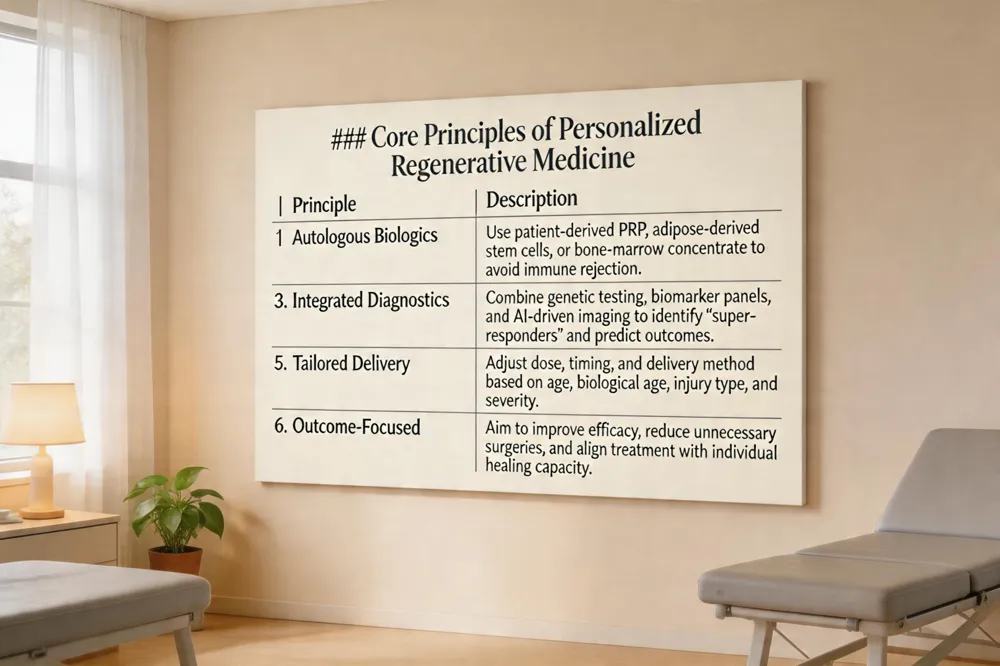
Core Principles of Personalized Regenerative Medicine
| Principle | Description |
|---|---|
| Autologous Biologics | Use patient‑derived PRP, adipose‑derived stem cells, or bone‑marrow concentrate to avoid immune rejection. |
| Integrated Diagnostics | Combine genetic testing, biomarker panels, and AI‑driven imaging to identify “super‑responders” and predict outcomes. |
| Tailored Delivery | Adjust dose, timing, and delivery method based on age, biological age, injury type, and severity. |
| Outcome‑Focused | Aim to improve efficacy, reduce unnecessary surgeries, and align treatment with individual healing capacity. |
 Core principles include:
- Use of autologous biologics (patient‑derived PRP, adipose‑derived stem cells) to avoid immune rejection.
- Integration of genetic testing, biomarkers, and AI‑driven imaging to identify "super‑responders" and predict outcomes.
- Tailoring dose, timing, and delivery method to age, biological age, injury type, and severity.
This personalized strategy improves efficacy, reduces unnecessary surgeries, and aligns treatment with each patient’s specific healing capacity.
Key Benefits of Personalization
Benefits of Personalized Regenerative Therapies
| Benefit | How It Manifests |
|---|---|
| Higher Efficacy | Matching growth‑factor concentration, stem‑cell type, and PRP formulation to patient biology yields greater pain reduction and faster functional recovery. |
| Reduced Side‑Effects | Autologous products minimize immune reactions; targeted pathways avoid unnecessary exposure. |
| Faster Recovery | Imaging‑guided injections and biomarker‑based dosing cut pain scores within weeks and lower invasive‑surgery rates by up to 30 %. |
| Cost Savings | Conservative, effective alternatives lower overall healthcare expenditures. |
| Patient Engagement | Real‑time outcome tracking and co‑creation of treatment plans improve adherence and long‑term outcomes. |
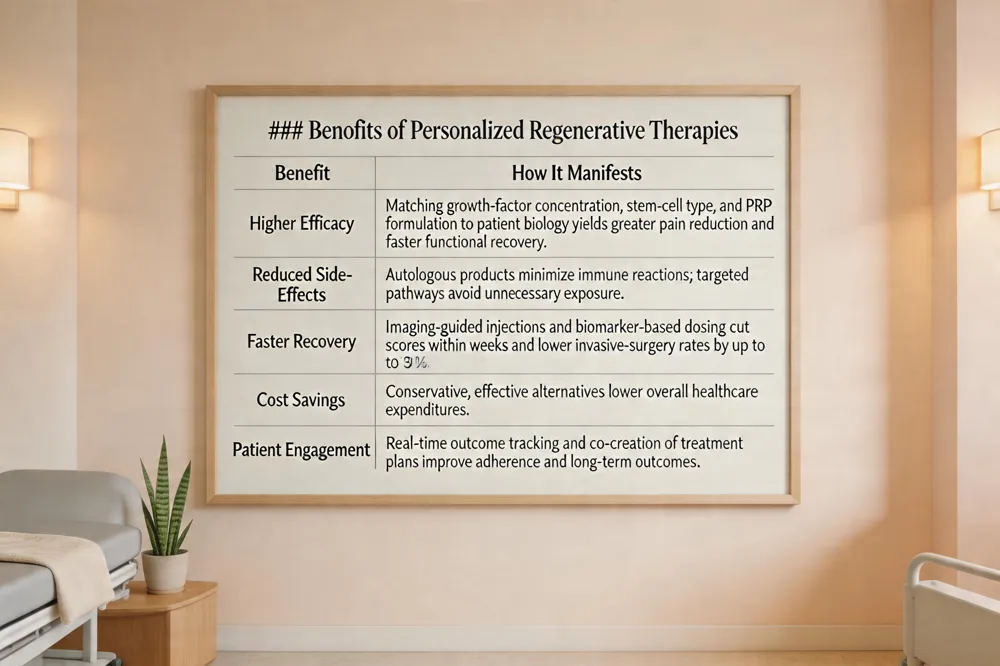 Personalized medicine tailors regenerative therapies to each patient’s unique genetic, cellular, and lifestyle profile, allowing clinicians to match the right concentration of growth factors, stem cells, or platelet‑rich plasma to the specific injury. This precision boosts therapeutic efficacy, as demonstrated by Mayo Clinic data showing “super‑responders” who experience markedly better outcomes when AI‑driven screening identifies the most responsive biologic. By targeting only the pathways relevant to the individual, unnecessary side‑effects are minimized, and the risk of immune reactions is reduced because autologous products are used. The patient‑centered approach also accelerates recovery: imaging‑guided injections, biomarker‑based dosing, and tailored rehabilitation programs have been shown to cut pain scores within weeks and lower the need for invasive surgery by up to 30 % in selected musculoskeletal conditions. In sum, personalization delivers a conservative, effective alternative to one‑size‑fits‑all treatments, improving healing while decreasing complications and overall healthcare costs.
The Four Ps of Personalized Medicine
The Four Ps of Personalized Medicine
| P | Definition |
|---|---|
| Predictive | AI‑driven genomic and biomarker screening forecasts individual risk (e.g., heart‑failure, stem‑cell response). |
| Preventive | Early interventions (e.g., PRP formulation adjustments) based on predictive data to halt disease progression. |
| Personalized | Customization of diagnostics and therapies—PRP concentration, stem‑cell source, rehab protocols—according to age, genetics, imaging, and comorbidities. |
| Participatory | Patients actively contribute outcome measures, share data, and co‑design treatment plans, boosting adherence. |
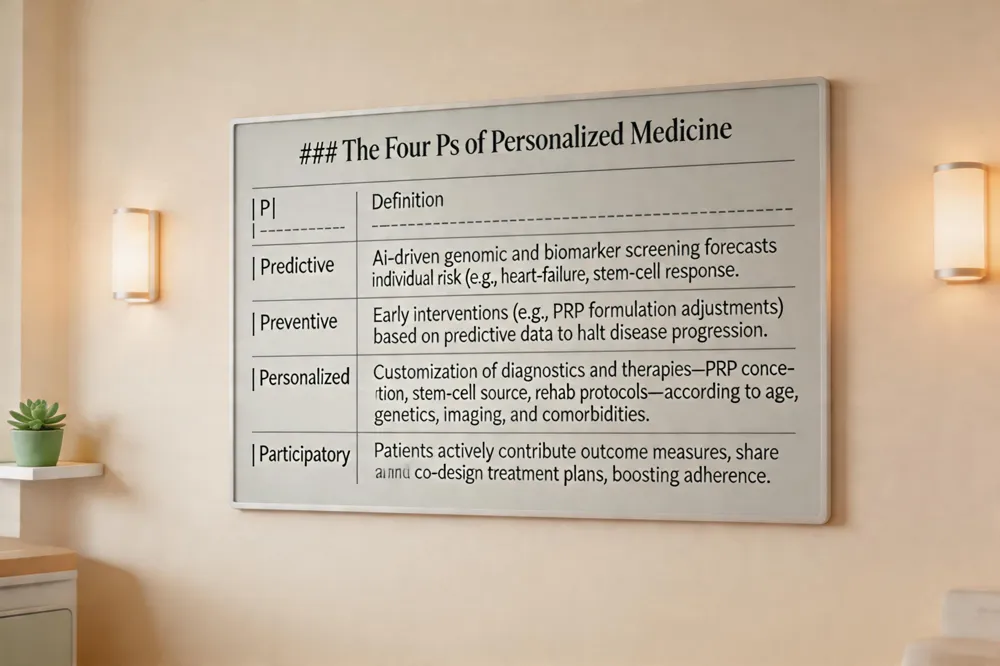 The four Ps of personalised medicine are Predictive, Preventive, Personalized, and Participatory. Predictive medicine leverages AI‑driven genomic and biomarker screening—such as the Mayo Clinic’s AI‑based panels—to forecast individual risk for variable heart‑failure‑ and super‑responders to stem‑cell therapy. Preventive medicine then uses those forecasts to intervene early, for example by adjusting platelet‑rich plasma (PRP) formulations or timing injections based on inflammatory cytokine levels, reducing the likelihood of disease progression. Personalized medicine tailors diagnostics and therapies to each patient’s unique biology: PRP concentration, stem‑cell source, and rehabilitation protocols are customized according to age, genetics, imaging findings, and comorbidities. Participatory medicine engages patients as active partners—collecting real‑time outcome measures, sharing imaging and biomarker data, and co‑creating treatment plans—so that decisions about regenerative interventions are made collaboratively, improving adherence and long‑term outcomes.
Is Personalized Therapy More Effective?
Evidence Supporting Effectiveness of Personalized Therapy
| Study / Trial | Personalized Approach | Outcome Compared to Standard Care |
|---|---|---|
| PRP Randomized Trials | Tailored platelet concentration, injection timing, and site based on imaging/biomarkers | Greater pain reduction and faster functional recovery. |
| CHART‑1 (Stem‑Cell) | Matching cell type and dosage to genetic variants and left‑ventricular size | Higher myocardial improvement rates. |
| Mayo Clinic AI Panels | Identification of “super‑responders” for stem‑cell therapy | Improved clinical outcomes and lower surgical escalation. |
| Patient‑Engagement Programs | Real‑time outcome tracking and co‑created rehab | Increased adherence, longer‑lasting recovery, lower relapse. |
 Clinical evidence increasingly shows that individualized regenerative protocols outperform generic, one‑size‑fits‑all regimens. Randomized trials of platelet‑rich plasma (PRP) demonstrate that tailoring platelet concentration, injection timing, and site to a patient’s specific injury, imaging findings, and biomarker profile yields greater pain reduction and faster functional recovery than standardized PRP doses. Similarly, stem‑cell studies reveal that patients screened for genetic variants and left‑ventricular size—such as those in the CHART‑1 trial—experience higher rates of myocardial improvement when cell‑type and dosage are matched to their biology. Personalized care also drives higher patient engagement; when patients understand that their treatment is designed around their unique health status, adherence to post‑procedure rehabilitation improves, leading to longer‑lasting recovery and lower relapse rates. By contrast, uniform protocols often overlook crucial variables like age‑related stem‑cell potency, comorbidities, or systemic inflammation, resulting in inconsistent outcomes and a higher likelihood of surgical escalation. Overall, the convergence of AI‑guided screening, genetic testing, and biomarker monitoring confirms that personalized regenerative therapy is more effective than generic approaches.
Your Path to Regenerative Care
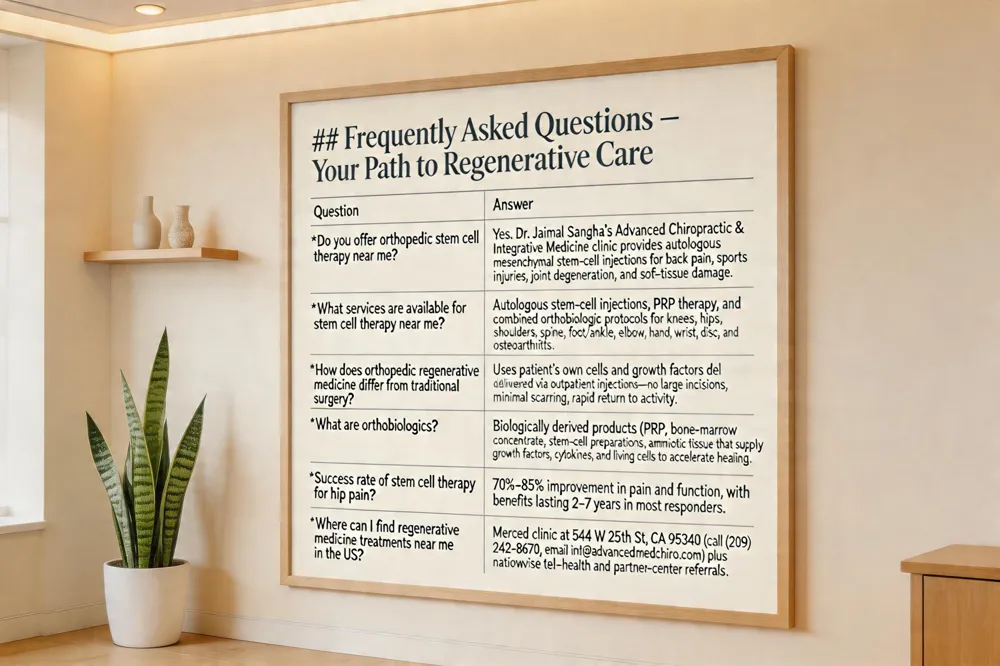
Frequently Asked Questions – Your Path to Regenerative Care
| Question | Answer |
|---|---|
| Do you offer orthopedic stem cell therapy near me? | Yes. Dr. Jaimal Sangha’s Advanced Chiropractic & Integrative Medicine clinic provides autologous mesenchymal stem‑cell injections for back pain, sports injuries, joint degeneration, and soft‑tissue damage. |
| What services are available for stem cell therapy near me? | Autologous stem‑cell injections, PRP therapy, and combined orthobiologic protocols for knees, hips, shoulders, spine, foot/ankle, elbow, hand, wrist, disc, and osteoarthritis. |
| How does orthopedic regenerative medicine differ from traditional surgery? | Uses patient’s own cells and growth factors delivered via outpatient injections—no large incisions, minimal scarring, rapid return to activity. |
| What are orthobiologics? | Biologically derived products (PRP, bone‑marrow concentrate, stem‑cell preparations, amniotic tissue) that supply growth factors, cytokines, and living cells to accelerate healing. |
| Success rate of stem cell therapy for hip pain? | 70 %–85 % improvement in pain and function, with benefits lasting 2–7 years in most responders. |
| Where can I find regenerative medicine treatments near me in the US? | Merced clinic at 544 W 25th St, CA 95340 (call (209) 242‑8670, email info@advancedmedchiro.com) plus nationwide tele‑health and partner‑center referrals. |
 Do you offer orthopedic stem cell therapy near me?
Yes. At Dr. Jaimal Sangha’s Advanced Chiropractic & Integrative Medicine clinic we provide autologous mesenchymal stem‑cell injections harvested from your own bone marrow or blood. The non‑surgical, patient‑centered procedure targets back pain, sports injuries, joint degeneration, and soft‑tissue damage. Ideal candidates are adults with chronic musculoskeletal pain who have tried conservative therapies and wish to avoid invasive surgery.
Do you offer orthopedic stem cell therapy near me?
Yes. At Dr. Jaimal Sangha’s Advanced Chiropractic & Integrative Medicine clinic we provide autologous mesenchymal stem‑cell injections harvested from your own bone marrow or blood. The non‑surgical, patient‑centered procedure targets back pain, sports injuries, joint degeneration, and soft‑tissue damage. Ideal candidates are adults with chronic musculoskeletal pain who have tried conservative therapies and wish to avoid invasive surgery.
What services are available for stem cell therapy near me? Our practice offers a full spectrum of regenerative treatments: autologous stem‑cell injections, platelet‑rich plasma (PRP) therapy, and combined orthobiologic protocols for knees, hips, shoulders, spine, and foot/ankle injuries. We also treat elbow, hand, wrist, disc, and osteoarthritis pain. Same‑day appointments are available at our Merced location, with tele‑medicine consults and partner centers nationwide.
How does orthopedic regenerative medicine differ from traditional surgery? Regenerative medicine uses the patient’s own cells and growth factors to stimulate natural repair, delivered as outpatient injections with no large incisions, minimal scarring, and rapid return to activity. Traditional surgery removes or replaces tissue, requires anesthesia, hospital stays, and carries higher infection and complication risks.
What are orthobiologics and how do they relate to regenerative medicine? Orthobiologics are biologically derived products—PRP, bone‑marrow concentrate, stem‑cell preparations, amniotic tissue—that supply growth factors, cytokines, and living cells to accelerate tissue healing. They are the biologic engine of regenerative protocols aimed at restoring cartilage, tendons, ligaments, and bone without surgery.
What is the success rate of stem cell therapy for hip pain? Clinical data show a 70 %–85 % improvement in pain and function for hip osteoarthritis or avascular necrosis after a series of stem‑cell injections, with benefits lasting 2–7 years in most responders.
Where can I find regenerative medicine treatments near me in the US? Visit our Merced clinic at 544 W 25th St, CA 95340, call (209) 242‑8670, or email info@advancedmedchiro.com. Nationwide tele‑health and partner‑center referrals make regenerative care accessible across the United States.
A Future Shaped by Individual Healing
Personalized regenerative medicine leverages AI‑driven screening, genetic testing, and biomarker analysis to match each patient’s unique biology with the most effective biologic therapy. By tailoring platelet‑rich plasma, stem‑cell, or exosome treatments to factors such as age, injury type, and inflammatory profile, clinicians can convert "super‑responders" into consistent beneficiaries while minimizing unnecessary procedures. This precision approach offers a compelling, minimally invasive alternative to surgery for back pain, sports injuries, carpal tunnel syndrome, and early osteoarthritis, often delivering faster pain relief, functional restoration, and a lower risk of complications. At our clinic, every evaluation begins with a comprehensive history, advanced imaging, and laboratory profiling, enabling us to design a truly patient‑centered plan that integrates regenerative injections with targeted rehabilitation, nutrition, and lifestyle counseling. We are dedicated to empowering individuals to harness their own healing potential, reducing reliance on invasive surgery and fostering lasting wellness.