A New Era for Regenerative Medicine
Since the COVID‑19 pandemic, telehealth use in the United States has exploded, rising 154% in 2020 and staying 38% above pre‑pandemic levels through 2024. This surge has opened a digital front door for regenerative medicine, allowing clinicians to screen, counsel and follow up on platelet‑rich plasma (PRP) therapy without requiring frequent office trips. Remote patient‑monitoring devices—wearable motion sensors, Bluetooth‑enabled blood‑pressure cuffs and mobile pain‑tracking apps—feed real‑time pain scores, range‑of‑motion data and activity levels into secure, HIPAA‑compliant platforms. AI‑driven analytics then personalize PRP dosing schedules and rehabilitation protocols, while virtual visits reinforce a patient‑centered, conservative model that prioritizes natural tissue healing over surgery. Studies show a 30% reduction in missed appointments and a 20% greater pain‑intensity improvement when telehealth‑guided PRP care is combined with continuous monitoring, confirming that digital tools can safely extend non‑surgical pain‑management pathways. Patients report higher satisfaction, averaging 85%, and lower overall costs from fewer in‑person visits significantly.
Telehealth Growth and Future Outlook
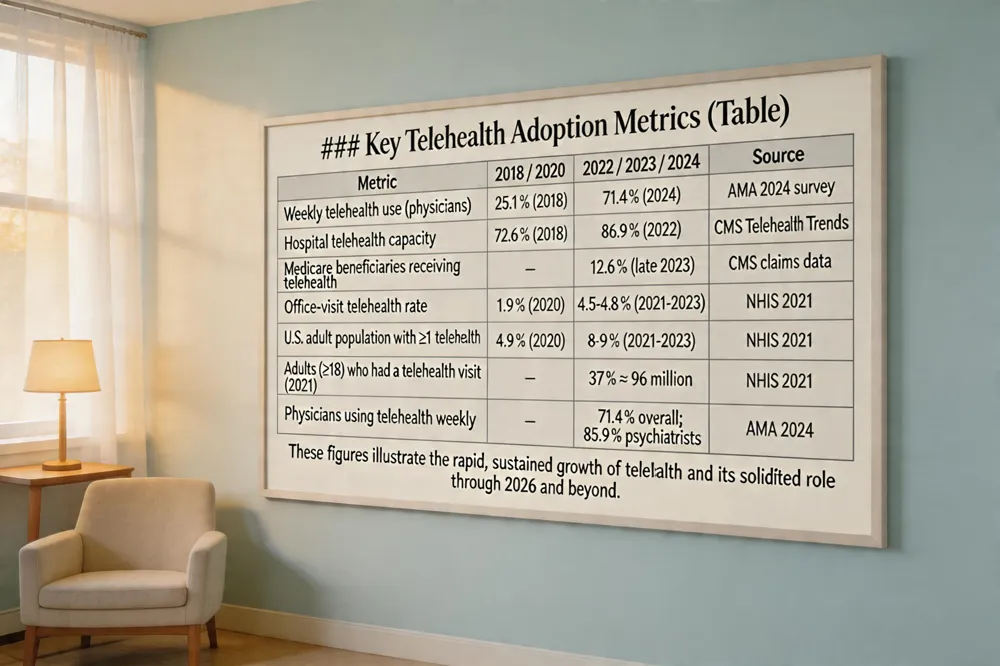
Key Telehealth Adoption Metrics (Table)
| Metric | 2018 / 2020 | 2022 / 2023 / 2024 | Source |
|---|---|---|---|
| Weekly telehealth use (physicians) | 25.1 % (2018) | 71.4 % (2024) | AMA 2024 survey |
| Hospital telehealth capacity | 72.6 % (2018) | 86.9 % (2022) | CMS Telehealth Trends |
| Medicare beneficiaries receiving telehealth | – | 12.6 % (late 2023) | CMS claims data |
| Office‑visit telehealth rate | 1.9 % (2020) | 4.5‑4.8 % (2021‑2023) | NHIS 2021 |
| U.S. adult population with ≥1 telehealth visit | 4.9 % (2020) | 8‑9 % (2021‑2023) | NHIS 2021 |
| Adults (≥18) who had a telehealth visit (2021) | – | 37 % ≈ 96 million | NHIS 2021 |
| Physicians using telehealth weekly (2024) | – | 71.4 % overall; 85.9 % psychiatrists | AMA 2024 |
These figures illustrate the rapid, sustained growth of telehealth and its solidified role through 2026 and beyond.
Will telehealth continue in 2026?
Yes. Medicare’s 2026 Consolidated Appropriations Act extended telehealth reimbursement through 2028, and private insurers have followed suit, guaranteeing access for patients and revenue for clinicians. This permanence lets regenerative‑medicine practices, such as Dr. Jaimal Sangha’s clinic, keep offering virtual assessments, remote monitoring, and PRP follow‑ups.
How many people use telehealth?
Approximately 37 % of U.S. adults—about 96 million people—reported at least one telehealth visit in the past year (2021 NHIS). Physician adoption is high: 71.4 % of doctors used telehealth weekly in 2024, with psychiatrists leading at 85.9 %.
Telehealth adoption statistics
Weekly telehealth use rose from 25.1 % (2018) to 71.4 % (2024). Hospital telehealth capacity grew from 72.6 % (2018) to 86.9 % (2022). Medicare claims show 12.6 % of beneficiaries received a telehealth service in late 2023.
What are the trends in telehealth?
Office‑visit telehealth rates increased from 1.9 % (2020) to roughly 4.5‑4.8 % (2021‑2023). The share of the population with a telehealth visit rose from 4.9 % to 8‑9 % in the same period, reflecting sustained, post‑pandemic integration of virtual care.
Virtual Urgent Care and Accessibility
Virtual Urgent‑Care Service Overview (Table)
| Service Type | Typical Availability | Common Conditions Treated | Coverage / Cost | Notable Feature |
|---|---|---|---|---|
| 24‑hour virtual urgent care | 24/7 via video on phone, tablet, computer | Back pain, sprains, flu‑like symptoms, skin rashes, minor infections | Often covered by insurance, FSA, or $0‑cost for members | Immediate access, no travel |
| Telehealth urgent care (non‑24‑hr) | Business hours (often extended) | Colds, flu, minor cuts, headaches, lower‑back pain | Most insurers cover; modest self‑pay fee | Prescriptions (no controlled substances) |
| Virtual urgent‑care Medicaid | Varies by state (often 24/7) | Minor injuries, flu‑like symptoms, back pain | Copay $0‑$30 or billed directly to Medicaid | Expands access for low‑income patients |
These modalities provide affordable, on‑demand care that complements in‑person urgent‑care clinics and supports regenerative‑medicine pathways such as PRP triage.
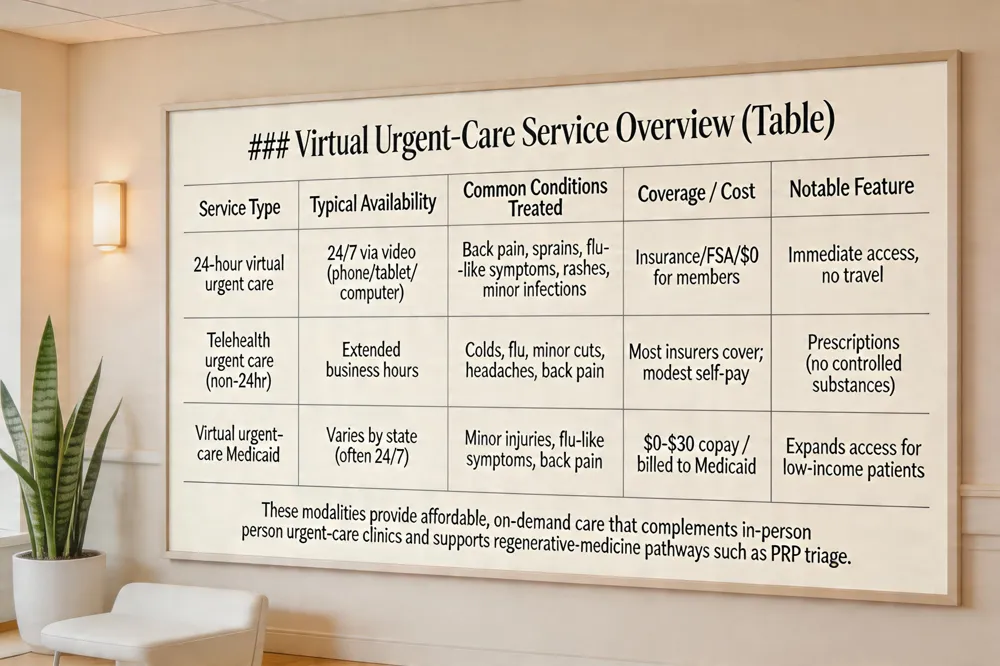 24‑hour virtual urgent care – 24‑hour virtual urgent‑care lets patients connect with a licensed provider via video from any device—phone, tablet, or computer—anytime day or night. It is ideal for non‑emergency issues such as back pain, sprains, flu‑like symptoms, skin rashes, or minor infections, offering quick assessment, prescription, and treatment recommendations without a trip to the office. Many platforms accept insurance, flexible‑spending accounts, or even offer $0‑cost visits for covered members, making it an affordable alternative to in‑person urgent‑care clinics. For those seeking regenerative‑medicine options like platelet‑rich plasma therapy, a virtual urgent‑care visit can triage symptoms and refer patients to a specialist for appropriate, non‑surgical treatment.
Telehealth urgent care – Telehealth urgent‑care services let patients connect with a licensed clinician via video from home, eliminating travel time and waiting‑room delays. These virtual visits can address a wide range of non‑emergency issues—such as colds, flu, minor cuts, headaches, and lower‑back pain—while still allowing the provider to prescribe medication (except controlled substances) and order labs if needed. Most insurers cover tele‑urgent care, and a self‑pay fee is typically modest, making it an affordable alternative to in‑person urgent‑care clinics.
Virtual urgent‑care Medicaid – Medicaid plans in many states now cover virtual urgent‑care visits, allowing members to see a board‑certified provider by video for non‑emergency issues such as minor injuries, flu‑like symptoms, or back pain. Services typically charge a modest copay (often $0–$30) or bill directly to the plan, supporting a conservative, patient‑centered approach by providing timely care without the need for an in‑person emergency‑room visit.
Mental Health and Telehealth
Tele‑Mental‑Health Utilization & Diagnosis Breakdown (Table)
| Metric | 2020 | 2023 |
|---|---|---|
| Share of all telehealth visits | 47 % | 58 % |
| Average tele‑mental‑health services per 1,000 people/month | 35 | – |
| Primary‑care tele‑services per 1,000 people/month | 15 | – |
| Common Diagnoses (percentage of tele‑mental visits) | Anxiety 18 %<br>Depression 9 %<br>PTSD 6 %<br>Adjustment disorders 5 % | – |
| Rural Medicaid tele‑mental encounters (Colorado) | 40 % of rural encounters | – |
| Urban commercially insured tele‑mental encounters (Colorado) | 42 % of urban encounters | – |
Tele‑mental‑health now constitutes the majority of virtual care, with robust adoption across both rural and urban populations.
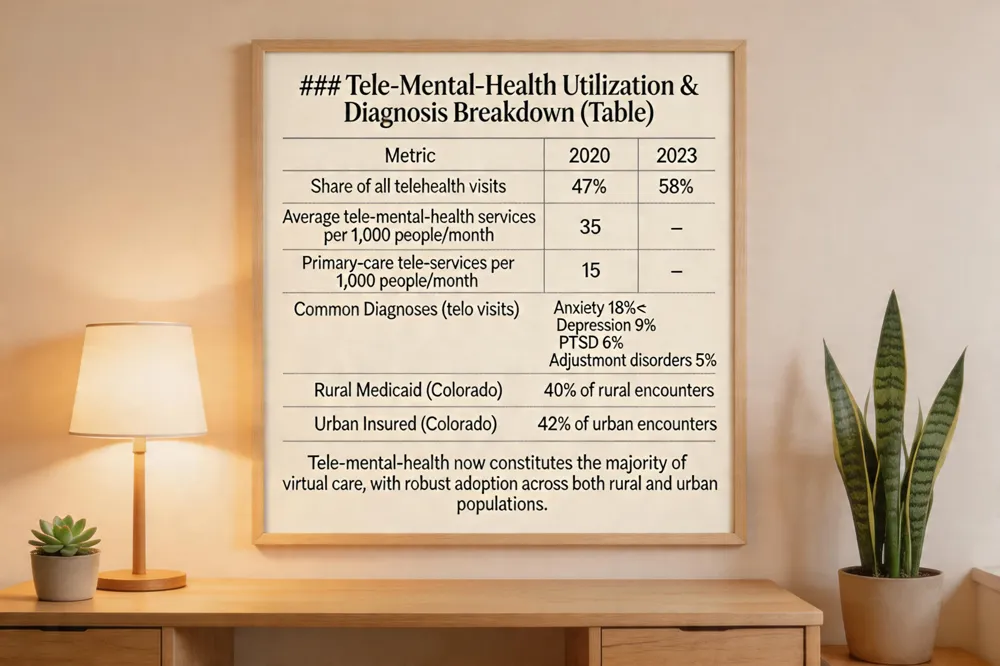 Tele‑mental‑health utilization has surged, accounting for 47 % of all telehealth visits in 2020 and rising to 58 % in 2023. Behavioral‑health providers deliver roughly 35 telehealth services per 1,000 people each month, far exceeding primary‑care rates of about 15 per 1,000. Common diagnoses include anxiety (18 %), depression (9 %), PTSD (6 %) and adjustment disorders (5 %).
Telehealth mental health statistics – Recent Colorado data show telehealth remains the dominant channel for mental‑health care, with Medicaid‑insured patients representing 40 % of rural encounters and commercially insured patients 42 % in urban counties.
The use of telehealth in healthcare articles 2025 – Literature now frames telehealth as a permanent pillar, highlighting AI‑enhanced virtual visits and mobile platforms that boost efficiency, patient engagement, and cost savings while emphasizing data‑privacy and EHR interoperability challenges.
CDC telehealth – CDC recommendations endorse live video, text reminders, and remote monitoring to improve chronic disease management, medication adherence, and patient‑centered, conservative care for pain and injury.
AI and Precision Medicine in Regenerative Care
AI‑Driven Applications in Regenerative Medicine (Table)
| AI Application | Data Inputs | Clinical Use | Reported Benefit |
|---|---|---|---|
| Genomic analysis for PRP response | Whole‑exome sequencing, SNP panels | Identify patients likely to benefit from PRP for back pain or sports injuries | ↑ PRP efficacy, reduced trial‑and‑error |
| Wearable‑sensor + EHR predictive modeling | Activity trackers, pain scores, medication logs | Predict flare‑ups of chronic musculoskeletal pain | Early intervention, lower pain episodes |
| NLP of radiology reports | Text of imaging reports | Flag candidates for minimally invasive regenerative therapies | Faster referral, higher appropriate‑use rate |
| Deep‑learning image quantification | MRI/ultrasound images | Quantify tissue degeneration, guide injection sites | Precise dosing, improved outcomes |
| Machine‑learning dosing optimizer | Biomarkers, prior outcomes, wearable data | Predict optimal PRP dose & timing | Shortened recovery, cost savings |
AI tools are reshaping personalized regenerative care by integrating multi‑modal data to predict response and tailor interventions.
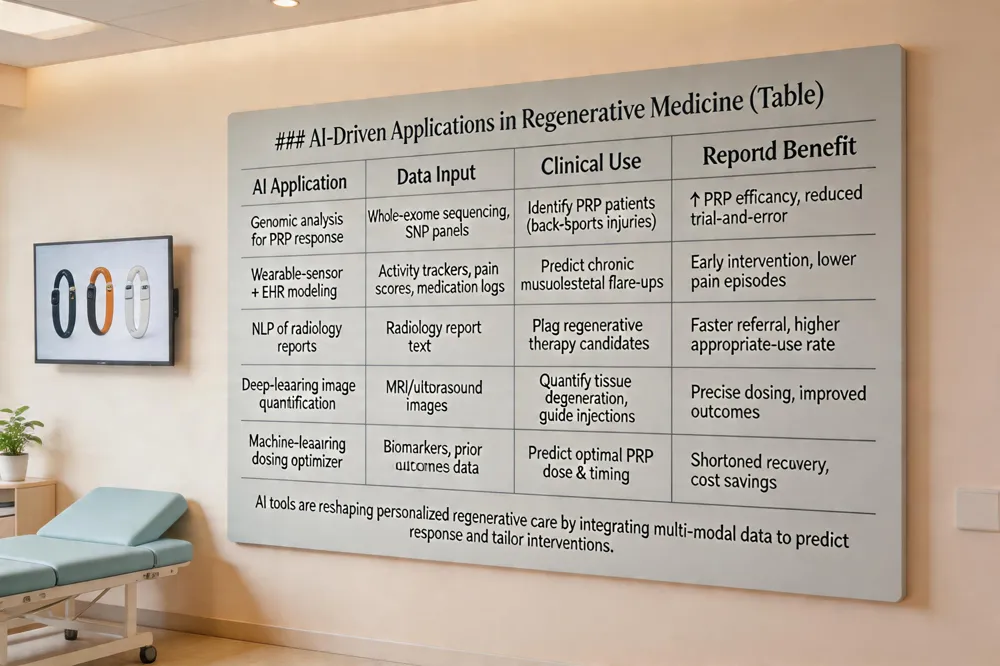 AI in precision medicine examples AI‑driven genomic analysis identifies patients likely to respond to PRP for back pain or sports injuries, while wearable‑sensor data combined with EHRs predict flare‑ups of chronic musculoskeletal pain. Natural‑language‑processing scans radiology reports to flag candidates for minimally invasive regenerative therapies, and deep‑learning image analysis quantifies tissue degeneration to guide precise injection sites.
Precision medicine, AI and the future of personalized health care Integrating genetic, clinical, and lifestyle data, AI uncovers hidden patterns and predicts individual responses to PRP, enabling clinicians to design customized, non‑surgical treatment plans that accelerate recovery and reduce surgery.
AI personalized medicine Machine‑learning models predict optimal PRP dosing and injection timing based on biomarkers, prior outcomes, and wearables, shortening recovery and minimizing trial‑and‑error.
AI in personalized medicine research paper Recent studies show AI‑derived predictive algorithms improve PRP efficacy for back pain, sports injuries, and carpal tunnel, supporting a conservative, patient‑centered approach.
AI in precision medicine journal The open‑access journal Artificial Intelligence in Precision Medicine publishes work on AI‑driven regimens, genomics, and ethical data handling, highlighting advances that personalize regenerative therapies.
What technology is used to create personalized medicine? Machine‑learning and deep‑learning algorithms analyze genomic, proteomic, imaging, and wearable data, turning molecular insights into actionable, patient‑specific treatment plans.
Digital Twins, Informatics, and Data Integration
Data Sources & Digital‑Twin Use Cases (Table)
| Data Source | Typical Content | Integration Role | Example Twin Application |
|---|---|---|---|
| EHR (clinical notes, labs) | Diagnoses, meds, labs | Core patient health record | Baseline health status for twin |
| RPM feeds (wearables) | Heart rate, activity, pain scores | Real‑time physiology | Dynamic update of twin’s pain trajectory |
| Genomics / proteomics | DNA variants, protein expression | Molecular profile | Predict PRP response in twin simulation |
| Imaging (MRI/US) | Structural images | Anatomical detail | Simulate injection site accuracy |
| Public datasets (CMS, HHS) | Utilization, demographics, outcomes | Population benchmarks | Validate twin predictions against real‑world data |
Digital twins combine these streams to create a living replica of each patient, enabling AI‑enhanced simulations of PRP therapy and outcome forecasting.
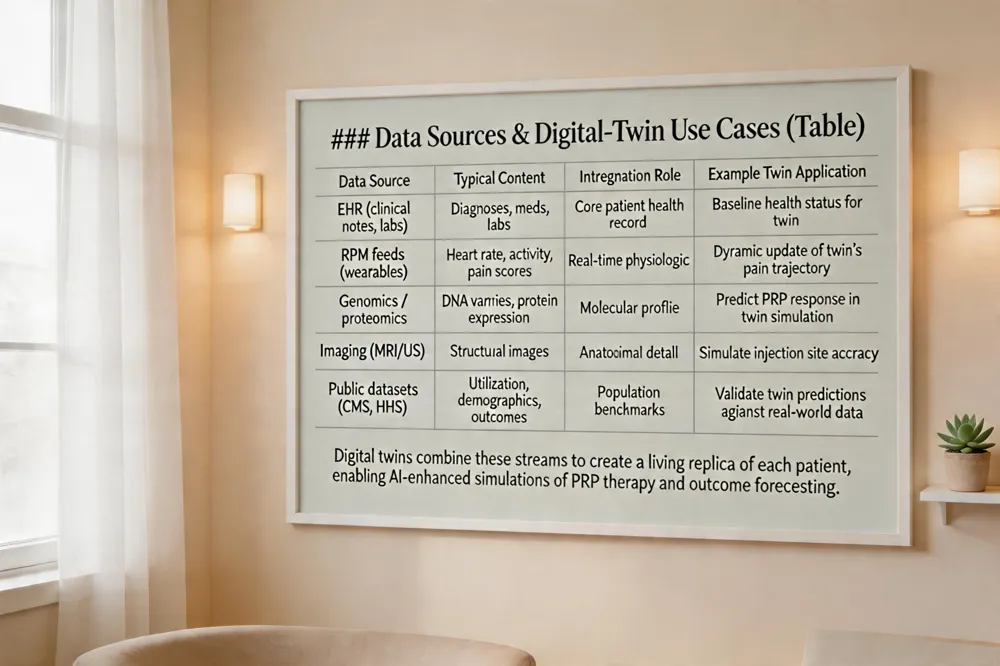 Clinical informatics is the backbone that turns telehealth encounters into actionable data, linking EHRs, health‑information exchanges, and RPM feeds to identify high‑risk patients and tailor regenerative therapies such as platelet‑rich plasma (PRP). Digital twins create dynamic, data‑driven replicas of individuals by merging real‑time physiology, genetics, wearables, and imaging; AI‑enhanced simulations predict PRP response, enabling personalized dosing and timing while supporting a conservative, patient‑centered pain-management approach. Public telehealth datasets—CMS Medicare Telehealth Trends (2020‑2025) and HHS Telehealth Data—provide granular usage, demographic, and outcome metrics that clinicians can download via CSV or API. These datasets help practices assess adoption trends, reimbursement eligibility, and cost‑effectiveness of virtual follow‑up, ensuring evidence‑driven integration of telehealth and digital‑ twin technology into everyday regenerative‑medicine care.
Patient‑Centered Benefits and Challenges
Advantages vs. Disadvantages of Telehealth (Table)
| Advantages | Disadvantages |
|---|---|
| • Removes geographic & scheduling barriers | • Limited physical exam capabilities |
| • Reduces travel time & cost | • Technology access gaps (broadband, devices) |
| • Enables remote monitoring of pain & function | • Privacy & data‑security concerns |
| • Higher patient satisfaction & convenience | • Variable insurance reimbursement across states |
| • Facilitates family involvement in visits | • Potential reduced in clinical assessment depth |
| • Decreases missed appointments & no‑shows | • Learning curve for both patients & providers |
Overall, telehealth delivers a net patient‑centered benefit, especially for chronic‑pain and regenerative‑care follow‑up, while requiring attention to technology equity and privacy safeguards.
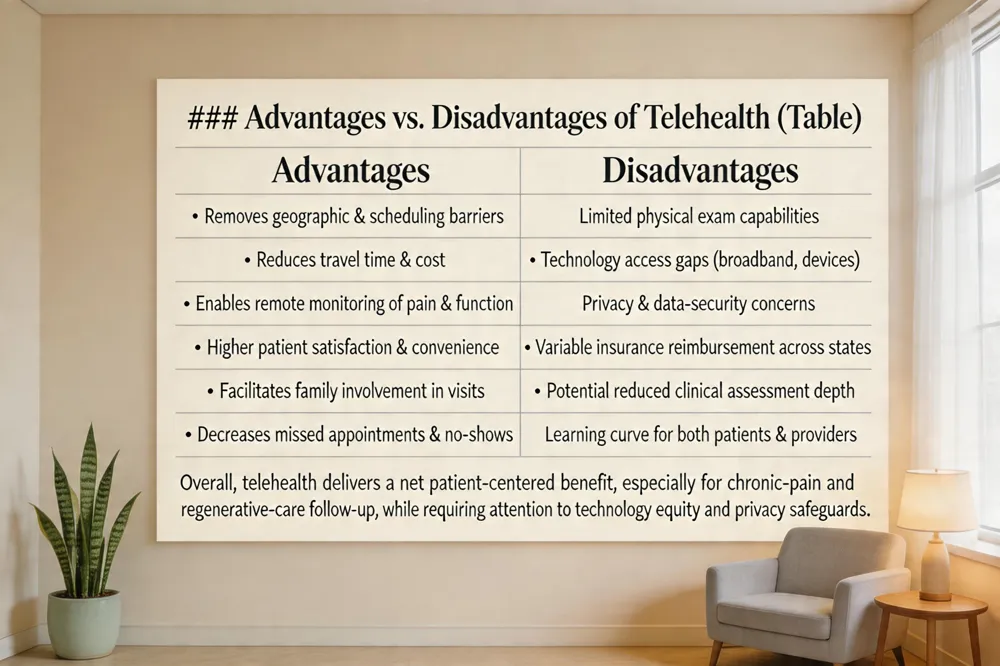 Telehealth improves continuity of care by removing geographic and scheduling barriers, allowing patients to attend virtual follow‑ups from home or work. Integrated video visits and EHR documentation keep treatment plans on track, while remote monitoring of pain scores and functional recovery enables timely adjustments to platelet‑rich‑plasma (PRP) therapy.
Scholarly evidence shows telehealth expands access for rural and underserved populations, yields high patient satisfaction, and achieves clinical outcomes comparable to in‑person visits for chronic pain, post‑operative follow‑up, and mental health. Economic analyses report lower overall costs through reduced travel, fewer missed appointments, and decreased hospital readmissions.
For patients, telehealth offers convenience, reduced travel time, and the ability to involve family members, while providers benefit from broader reach, lower no‑show rates, streamlined documentation, and enhanced work‑life balance.
Advantages include increased access, cost savings, and continuous monitoring; disadvantages involve limited physical exams, technology gaps, and privacy concerns.
A virtual doctor can assess and treat strep throat via video, prescribing antibiotics and home‑care guidance.
The most affordable no‑insurance telehealth option is Sesame, with visits starting at $34.
Future Directions, Personalized Care, and Policy
Emerging Trends & Policy Highlights (Table)
| Trend / Policy | Description | Impact on Regenerative Care |
|---|---|---|
| AI‑powered diagnostics | Real‑time image and data analysis | Faster, more accurate PRP candidate selection |
| Smart remote‑patient‑monitoring wearables | Continuous physiologic tracking | Enables dynamic dosing adjustments |
| HIPAA‑compliant messaging platforms | Secure chat/video for follow‑up | Improves patient engagement, reduces delays |
| Advanced cybersecurity (zero‑trust) | Protects patient data across platforms | Builds trust for sensitive genomic & PRP data |
| Immersive AR examination tools | Remote overlay of imaging on patient view | Enhances virtual physical assessments |
| Federal telehealth reimbursement extensions (2026‑2028) | Medicare & private insurer coverage continuity | Guarantees revenue stream for virtual regenerative services |
| State Medicaid virtual urgent‑care coverage | Low‑cost access for underserved | Expands PRP triage to low‑income populations |
These trends and policy moves position telehealth as a permanent, AI‑enhanced pillar of personalized regenerative medicine.
 Hyper‑personalized medicine
 tailors prevention and treatment to each patient’s unique genetic, molecular, environmental, and lifestyle profile. By integrating real‑time data from wearables, EHRs, and multi‑omics, clinicians can fine‑tune platelet‑rich plasma (PRP) protocols, dosing, and adjunctive lifestyle recommendations, supporting natural healing while minimizing surgery.
Hyper‑personalized medicine
Hyper‑personalized medicine tailors prevention and treatment to each patient’s unique genetic, molecular, environmental, and lifestyle profile. By integrating real‑time data from wearables, EHRs, and multi‑omics, clinicians can fine‑tune platelet‑rich plasma (PRP) protocols, dosing, and adjunctive lifestyle recommendations, supporting natural healing while minimizing surgery.
Telehealth care services Telehealth enables patients of Advanced Integrative Medicine to consult Dr. Jaimal Sangha remotely for assessments, medication reviews, and detailed PRP education. Secure, HIPAA‑compliant video visits allow sharing of imaging, lab results, and progress notes, expanding access to non‑surgical pain management across the United States.
Virtual care Through an online portal, patients schedule video appointments, discuss back pain, sports injuries, or carpal tunnel, and involve family members in the care plan. Real‑time video, image sharing, and EHR integration ensure thorough evaluation and continuous monitoring of recovery.
Impact of telemedicine on healthcare Telemedicine breaks geographic barriers, reduces travel costs, and improves efficiency via remote monitoring and streamlined coordination. It supports patient‑centered, conservative regenerative therapies that require frequent follow‑up, though success hinges on broadband access, regulatory support, and patient adoption.
What topics are trending in telemedicine tech? Trending technologies include AI‑powered diagnostics, smart remote‑patient‑monitoring wearables, HIPAA‑compliant messaging platforms, advanced cybersecurity, and immersive AR tools for remote examinations.
A Vision for Conservative, Data‑Driven Healing
Telehealth has become a permanent pillar of U.S. health‑care, scaling from a pandemic surge to a 38 % increase in 2023 and a 154 % jump in 2020 versus 2019 (CDC, CMS). Platforms now integrate electronic health records, wearable sensor streams, and remote‑patient‑monitoring (RPM) devices, enabling clinicians to track pain scores, range of motion, and activity levels in real time. Artificial‑intelligence triage and decision‑support tools analyze these data alongside imaging and biomarkers, personalizing dosing schedules and predicting optimal timing for platelet‑rich plasma (PRP) injections. This data‑driven approach supports a conservative, patient‑centered model: patients receive education, virtual physiotherapy, and continuous feedback without invasive surgery. Regenerative clinics report a 30 % drop in missed appointments and higher adherence when tele‑follow‑up is combined with AI‑guided rehabilitation, delivering comparable outcomes to in‑person care while reducing travel and cost. Insurance carriers now reimburse RPM and telehealth visits at parity, further encouraging widespread adoption and sustainable revenue for integrative practices.