Why Musculoskeletal Health Matters
The musculoskeletal system forms the structural backbone of every movement, keeping the spine aligned, joints stable, and posture upright. When muscles, bones, tendons, and ligaments function together, individuals can walk, lift, and perform daily tasks without pain or limitation. Beyond mechanics, strong musculoskeletal fitness supports metabolic health: weight‑bearing activity stimulates bone remodeling, improves insulin sensitivity, and helps maintain an ideal body weight, reducing the risk of obesity, type 2 diabetes, and cardiovascular disease. Equally important, chronic musculoskeletal pain triggers stress hormones, lowers mood, and can precipitate anxiety or depression; conversely, regular exercise and mind‑body practices such as yoga or tai chi lower cortisol, enhance neurochemical balance, and improve mental well‑being. Across the lifespan, preserving musculoskeletal integrity—from childhood through older age—prevents early joint degeneration, sarcopenia, and osteoporosis, keeping functional independence and quality of life high while diminishing the need for invasive surgery or long‑term medication.
Building Strength and Flexibility for Longevity
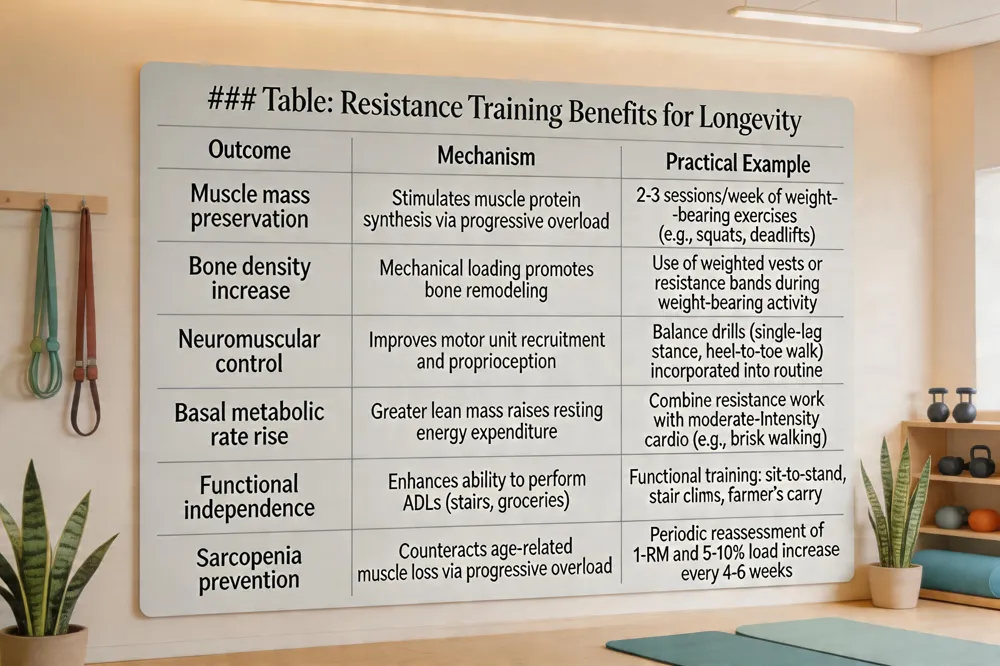
Table: Resistance Training Benefits for Longevity
| Outcome | Mechanism | Practical Example |
|---|---|---|
| Muscle mass preservation | Stimulates muscle protein synthesis via progressive overload | 2‑3 sessions/week of weight‑bearing exercises (e.g., squats, deadlifts) |
| Bone density increase | Mechanical loading promotes bone remodeling | Use of weighted vests or resistance bands during weight‑bearing activity |
| Neuromuscular control | Improves motor unit recruitment and proprioception | Balance drills (single‑leg stance, heel‑to‑toe walk) incorporated into routine |
| Basal metabolic rate rise | Greater lean mass raises resting energy expenditure | Combine resistance work with moderate‑intensity cardio (e.g., brisk walking) |
| Functional independence | Enhances ability to perform ADLs (stairs, groceries) | Functional training: sit‑to‑stand, stair climbs, farmer’s carry |
| Sarcopenia prevention | Counteracts age‑related muscle loss via progressive overload | Periodic reassessment of 1‑RM and 5‑10 % load increase every 4‑6 weeks |
 Why is musculoskeletal health important? The musculoskeletal system provides the structural framework that supports the body’s weight, maintains posture, and enables movement. Poor musculoskeletal health can limit mobility, reduce dexterity, lead to early retirement, lower overall well‑being, and diminish participation in everyday activities.
Resistance training benefits are profound: regular weight‑bearing and strength exercises stimulate muscle protein synthesis, improve neuromuscular control, and raise basal metabolic rate, helping preserve lean mass and metabolic health. These adaptations translate into greater functional independence for older adults, allowing them to perform daily tasks such as climbing stairs, carrying groceries, and maintaining balance.
Bone density and sarcopenia prevention are tightly linked to resistance training. Mechanical loading promotes bone remodeling, increasing mineral density and reducing osteoporosis risk, while progressive overload counters age‑related muscle loss (sarcopenia). Together, these effects maintain locomotor capacity, support intrinsic capacity, and keep older individuals active and engaged in society.
Regenerative Medicine: PRP and Beyond
Table: Platelet‑Rich Plasma (PRP) Therapy Overview
| Component | Role in Tissue Healing | Primary Clinical Indications |
|---|---|---|
| Growth factors (PDGF, TGF‑β, VEGF) | Stimulate cellular proliferation, collagen synthesis, angiogenesis | Chronic low‑back pain, tendinopathies, carpal tunnel syndrome |
| Autologous platelets | Deliver high concentration of cytokines directly to injury site | Early‑stage musculoskeletal injuries, post‑surgical augmentation |
| Anti‑inflammatory modulation | Reduce pro‑inflammatory mediators, limit fibrosis | Osteoarthritis knee pain, rotator cuff tendinitis |
| Procedure | Small‑volume blood draw → centrifugation → activation → injection | Outpatient setting, typically 1‑3 sessions per condition |
| Outcomes | Pain reduction (≥30 % VAS), functional improvement (≥15 % WOMAC) | Delays surgery, lowers opioid use, supports faster return to activity |
| Adjunctive care | Combined with PT, ergonomics, nutrition, mind‑body techniques | Comprehensive conservative management plan |
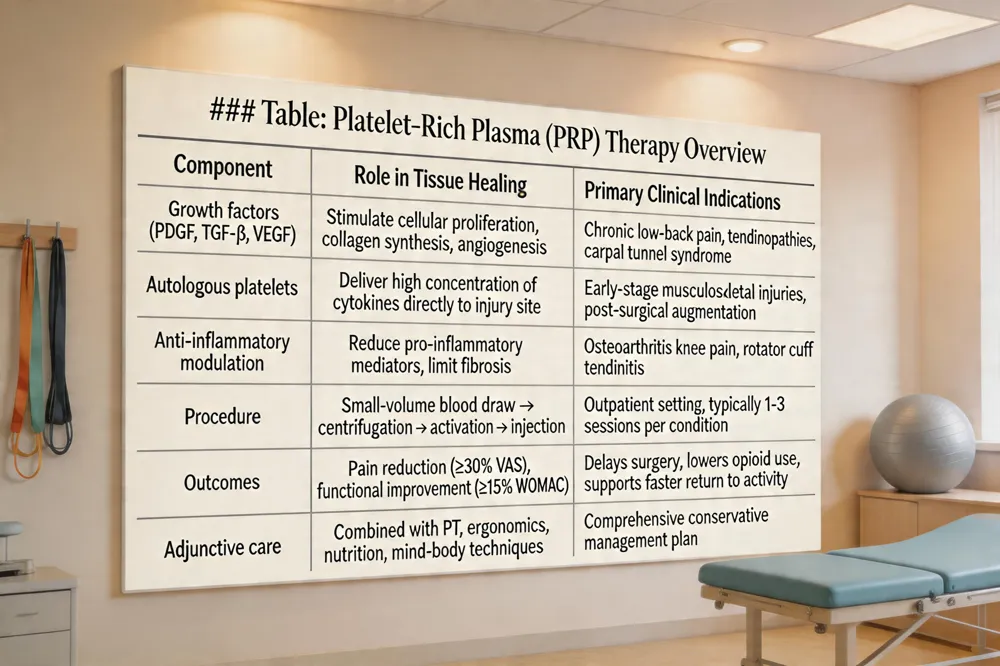 Platelet‑Rich Plasma (PRP) therapy concentrates a patient’s own platelets and injects them into injured musculoskeletal tissue, delivering a high dose of growth factors (PDGF, TGF‑β, VEGF) that stimulate cellular proliferation, collagen synthesis, angiogenesis, and modulation of inflammation. Clinical trials and systematic reviews consistently demonstrate that PRP reduces pain and improves function in chronic low‑back pain, sports‑related tendinopathies, and carpal tunnel syndrome, often delaying or avoiding surgery. A patient‑centered, conservative care model places PRP alongside targeted physical therapy, ergonomic education, nutrition counseling, and mind‑body techniques, emphasizing early non‑surgical intervention, shared decision‑making, and ongoing outcome monitoring. This integrative approach not only accelerates tissue repair but also supports overall musculoskeletal health, lowers opioid reliance, and enhances long‑term functional independence.
Integrative Approaches: Nutrition, Mind‑Body, and Ergonomics
Key nutrients – Vitamin D, calcium and collagen are pillars of musculoskeletal health. Vitamin D deficiency is the most common vitamin deficiency linked to musculoskeletal pain; low 25‑hydroxyvitamin D (<20 ng/mL) weakens bone mineralization and reduces muscle strength, producing deep aching pain in the back, hips and ribs. Calcium works with vitamin D to build and maintain bone density, while hydrolyzed collagen supplementation supports cartilage integrity and can reduce joint discomfort.
Mind‑body practices – Regular yoga, tai chi and mindfulness‑based stress reduction improve flexibility, balance and pain perception. These practices lower cortisol, modulate central pain pathways and have been shown to lessen low‑back and knee pain.
Ergonomic interventions for workplace health – Ergonomic interventions, proper chair support, and frequent micro‑breaks prevent repetitive‑strain injuries. Educating employees on neutral posture and encouraging brief stretching every hour reduces neck, shoulder and lower‑back strain, preserving overall functional capacity.
Navigating Healthcare: Insurance, Access, and Patient Education
Insurance coverage for integrative services
Coverage varies by insurer, plan, and state. Many commercial and government policies reimburse select modalities—acupuncture (≈40‑50 % of plans), chiropractic care (≈89 % of plans), and, in some regions, naturopathic services—but often limit visit numbers and may require a physician referral or proof of medical necessity. Medicare Part B, for example, pays for up to 12 acupuncture sessions for chronic low‑back pain and manual spinal manipulation. Overall, integrative services are less consistently covered than conventional primary‑care, so patients frequently use a cash‑pay or hybrid model and should verify benefits before scheduling.
Patient‑centered treatment planning
A conservative, patient‑centered model integrates physical therapy, ergonomic education, nutrition, mind‑body techniques, and regenerative options such as platelet‑rich plasma (PRP). Early, non‑surgical interventions lower surgical risk, reduce opioid use, and improve satisfaction. Shared decision‑making tailors interventions to individual anatomy, activity level, and health goals, empowering patients to prioritize lifestyle modifications alongside targeted therapies.
Self‑management strategies
Education on proper body mechanics, regular low‑impact exercise, stretching, adequate hydration, and anti‑inflammatory nutrition (calcium, vitamin D, omega‑3s) supports musculoskeletal health. Mindfulness, yoga, and stress‑reduction techniques further diminish perceived pain and improve adherence to rehabilitation plans.
Q: Does insurance cover integrative medicine?
Coverage is inconsistent; some plans reimburse acupuncture, chiropractic, and limited regenerative therapies, but many require referrals, have visit caps, or are cash‑only.
Q: Is musculoskeletal pain related to arthritis?
Yes—arthritis (osteoarthritis, rheumatoid arthritis, etc.) is a common source of musculoskeletal pain, but pain can also stem from injuries, overuse, infections, or other connective‑tissue disorders.
Future Directions: Rehabilitation 2030 and Global Impact
The WHO Rehabilitation 2030 initiative designates rehabilitation as an essential health service, urging universal access across the life‑course. Central to this agenda is a Package of Interventions that includes evidence‑based, non‑surgical treatments for low‑back pain, osteoarthritis, sarcopenia, fractures and amputations, supporting the integration of musculoskeletal care into primary health systems. Globally, musculoskeletal conditions affect roughly 1.71 billion people and account for about two‑thirds of all rehabilitation needs, with low‑back pain alone responsible for 7.4 % of years lived with disability. Emerging public‑health strategies emphasize early, conservative management—combining ergonomics, targeted exercise, nutrition, mind‑body techniques, and regenerative therapies such as platelet‑rich plasma (PRP). These approaches aim to reduce pain, preserve functional independence, and curb the downstream risk of cardiovascular disease, obesity and mental‑health disorders, aligning with WHO’s goal of fostering a patient‑centered, non‑surgical care model that mitigates the worldwide musculoskeletal burden.
Putting It All Together for a Pain‑Free Future
Achieving lasting pain‑free living requires a blended, patient‑centered plan that merges movement, nutrition, and regenerative therapies. Aerobic work, progressive resistance training, and flexibility preserve joint stability, bone density, and muscle mass while reducing inflammation. Anti‑inflammatory diets rich in omega‑3s, calcium, vitamin D, and protein support tissue repair and metabolic health. Yoga and stress‑reduction lower cortisol and improve pain perception. Empowered individuals educated about body mechanics and self‑management can choose non‑surgical options such as platelet‑rich plasma injections, which accelerate healing and minimize surgery. Take the first step today: schedule a musculoskeletal assessment and explore regenerative care as part of your wellness roadmap.