Why Understanding Hair Loss Matters
Hair loss is a common condition, affecting up to 80 % of men and roughly 50 % of women by age 70, with an estimated 40 million men and 20 million women in the United States experiencing noticeable thinning. The psychological toll can be profound: many patients report reduced self‑esteem, increased anxiety, and a decline in overall quality of life, especially when hair loss is sudden, patchy, or visibly disfiguring. An integrative, patient‑centered approach—combining thorough diagnostic work‑ups (history, physical exam, labs), lifestyle counseling (nutrition, stress reduction), and evidence‑based therapies such as minoxidil, finasteride, low‑level laser therapy, and regenerative options like platelet‑rich plasma—addresses both the biological causes and the emotional impact. By viewing hair loss through a holistic lens, clinicians can tailor interventions that not only slow follicular miniaturization but also support patients’ confidence and long‑term scalp health.
Hormones, Nutrition, and the Roots of Hair Shedding
 Hair loss stems from a complex mix of hormonal, nutritional, and lifestyle factors.
Which hormone causes hair loss in females? Dihydrotestosterone (DHT), a potent testosterone metabolite, is the primary driver of female‑pattern alopecia. When estrogen falls—such as during menopause—DHT activity predominates, binding to follicular androgen receptors, shortening the anagen phase, and causing miniaturization that widens the part and thins the crown.
Which vitamin deficiencies can cause hair loss? Deficiencies in vitamin D, iron, vitamin B12, biotin (B7), zinc, and vitamin A all impair follicle health. Vitamin D and iron influence the growth cycle and oxygen delivery; B12 and biotin affect keratin synthesis; zinc supports structural integrity; and vitamin A regulates cell turnover.
What are the main causes of hair loss in women? Hormonal shifts (pregnancy, postpartum, menopause), genetic predisposition to female‑pattern alopecia, iron and vitamin D deficiencies, thyroid disorders, anemia, rapid weight loss, stress, harsh chemicals, tight hairstyles, and certain medications (e.g., chemotherapy) each contribute to diffuse thinning and shedding.
What are the main causes of hair loss in men? Androgenetic alopecia driven by DHT is the leading cause, amplified by family history and aging. Additional triggers include thyroid disease, anemia, autoimmune alopecia, nutritional deficits (iron, protein), stress, rapid weight loss, scalp trauma, and medications that disrupt the hair cycle.
Addressing hormonal balance, correcting micronutrient gaps, and mitigating stress or mechanical trauma are essential steps in a patient‑centered, evidence‑based approach to halting and reversing hair shedding.
From Exam to Lab: How Hair Loss Is Diagnosed
 A thorough hair‑loss work‑up begins with a detailed medical and family history followed by a physical scalp examination. The clinician inspects the pattern of thinning, checks for signs of inflammation, and performs a pull test—gently tugging a small bundle of hairs to see how many come out, which helps differentiate telogen effluvium from patterned loss. When the visual exam suggests an underlying systemic issue, laboratory tests are ordered. A complete blood count screens for anemia, while ferritin, iron, and total iron‑binding capacity evaluate iron stores. Thyroid‑stimulating hormone, free T4, and sometimes thyroid antibodies assess thyroid function, and a 25‑hydroxy vitamin D level detects deficiency that can exacerbate shedding. In select cases, a scalp biopsy or light microscopy is performed; a punch biopsy can reveal scarring alopecia, fungal infection, or autoimmune patterns, and trichoscopy (dermoscopic imaging) highlights follicular miniaturization or exclamation‑point hairs characteristic of androgenetic alopecia. To maximize the specialist visit, patients should bring a list of current medications and supplements, recent lab results, and specific questions about possible causes, testing options, and insurance coverage for diagnostics or treatments.
Regenerative Non‑Surgical Therapies That Work
What are the best hair‑restoration options available today?
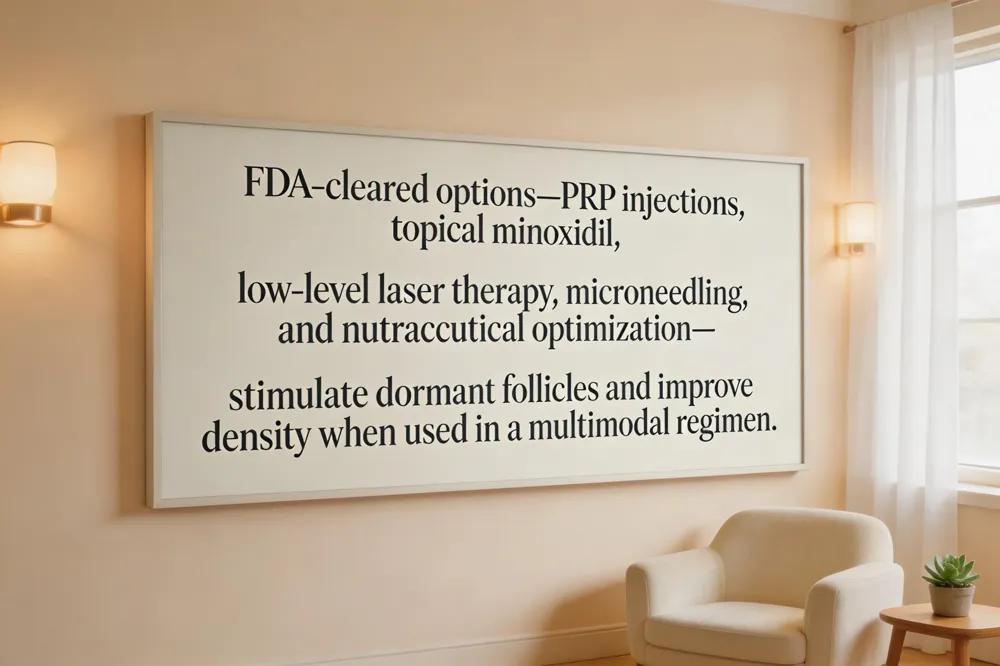
A balanced approach that starts with FDA‑approved, non‑surgical modalities yields the most reliable outcomes. Platelet‑Rich Plasma (PRP) injections deliver autologous growth factors (PDGF, TGF‑β, VEGF) directly to the scalp, stimulating dormant follicles and improving vascularity. Topical Minoxidil (5 % for men, 2 % for women) prolongs the anagen phase, while Low‑Level Laser Therapy (LLLT) enhances cellular metabolism through red‑light photobiomodulation. For men with androgen‑dependent thinning, oral Finasteride (1 mg) or off‑label Dutasteride further reduces DHT‑driven miniaturization; women may benefit from anti‑androgenic Spironolactone. Adjuncts—including microneedling, exosome‑rich serums, and optimized nutrition (iron, zinc, vitamin D, biotin)—support follicular health and amplify results.
What is the best non‑surgical hair restoration approach?
The highest success rate comes from a combined regimen: a series of three to four PRP sessions spaced 4‑6 weeks apart, daily Minoxidil application, and LLLT 2‑3 times per week. Nutritional optimization and stress‑management further sustain gains.
How does PRP hair treatment work for women?
A small blood draw is centrifuged to concentrate platelets; the platelet‑rich plasma is injected into thinning scalp zones. Growth factors boost blood flow, reduce inflammation, and shift follicles into the anagen phase, increasing shaft thickness and density. The procedure is minimally invasive and can be paired with Minoxidil or anti‑androgens for added benefit.
What are the side effects of PRP hair treatment?
Most patients experience only mild, transient reactions: temporary swelling, bruising, redness, or soreness that resolve within a few days. Rare complications include infection or isolated nodules, but serious adverse events are exceedingly uncommon.
Is PRP painful for hair restoration?
Discomfort is minimal, often described as a brief pressure or stinging sensation. Topical anesthetic creams or cooling devices are frequently used to enhance comfort; downtime is negligible.
What is the success rate of PRP hair treatment?
Across randomized trials, PRP yields a 30‑40 % increase in hair density, with 60‑70 % of patients reporting noticeable thickening after a standard 3‑4‑session protocol. Overall, about three‑quarters of treated individuals achieve a clinically significant improvement in hair count or coverage.
Medical Therapies and Hormone Modulation
 Finasteride, dutasteride, and spironolactone act by blocking the conversion of testosterone to dihydrotestosterone (DHT) or by antagonizing androgen receptors, thereby reducing DHT‑driven follicular miniaturization. Finasteride (1 mg daily) is FDA‑approved for men and is the most effective systemic option for male‑pattern alopecia; dutasteride, a more potent 5‑α‑reductase inhibitor, is used off‑label when finasteride fails. Spironolactone, an anti‑androgen diuretic, is the first line for women who cannot take finasteride, especially when hyperandrogenism is present. Low‑dose oral minoxidil (0.25–5 mg daily) has emerged as an effective alternative to topical formulations, delivering vasodilation and anagen‑phase prolongation with minimal systemic side effects. Combining medications with regenerative modalities—such as platelet‑rich plasma (PRP) injections—enhances outcomes: PRP supplies growth factors that reactivate dormant follicles while finasteride or minoxidil suppress ongoing hormonal loss. This multimodal, patient‑centered approach is supported by clinical data showing synergistic increases in hair density and thickness, particularly in early‑stage androgenetic alopecia.
Surgical Restoration and Long‑Term Planning
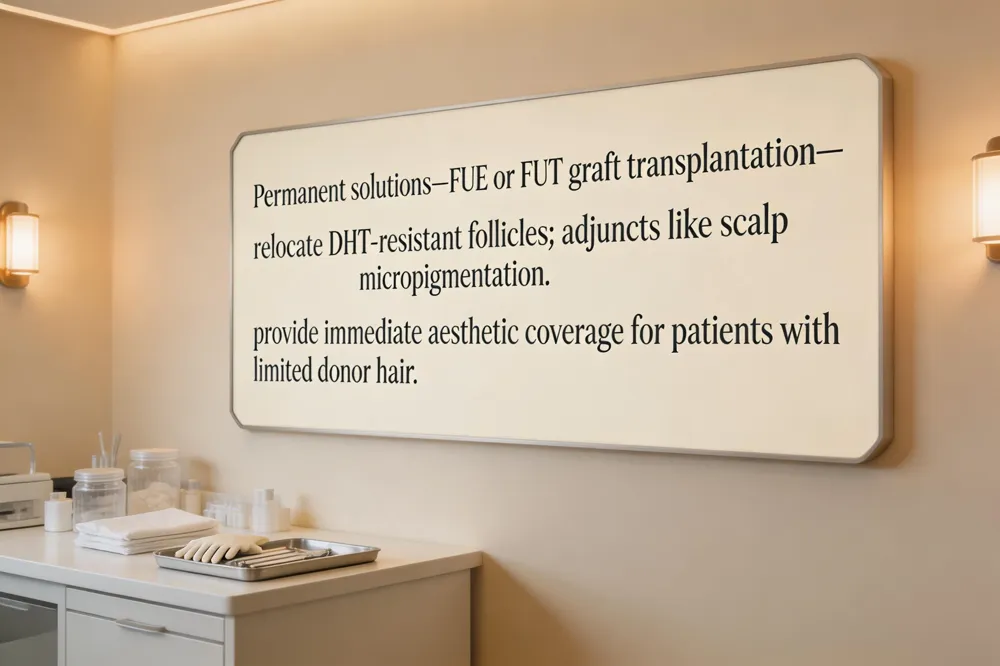 Follicular Unit Extraction (FUE) and Follicular Unit Transplantation (FUT) are the two FDA‑cleared surgical paths for permanent hair restoration. FUE harvests individual follicles with a micro‑punch, leaving tiny dot scars and a faster recovery; FUT removes a thin strip of donor scalp, which is dissected into grafts and yields a higher graft count per session but leaves a linear scar. Both techniques relocate DHT‑resistant follicles that continue to grow for a lifetime once implanted in the recipient zone.
Scalp micropigmentation (SMP) and other advanced cosmetic options—such as fiber powders, hair‑building sprays, and permanent tattoo‑style pigmentation—provide immediate visual density without altering biology. SMP is especially useful when surgical candidates lack sufficient donor hair or desire a non‑invasive aesthetic boost.
Surgery becomes the appropriate choice when a patient has stable donor‑site hair, progressive pattern baldness, and realistic expectations about graft survival and postoperative care. Non‑surgical modalities—PRP, low‑level laser therapy, minoxidil, finasteride, spironolactone—can slow loss and stimulate regrowth but require lifelong use and do not offer a permanent cure.
What permanent hair‑restoration options exist? Surgical transplantation (FUE or FUT) is the only truly permanent solution; non‑surgical treatments are temporary.
What hair‑restoration options are available for females? PRP, topical minoxidil, low‑level laser therapy, anti‑androgens (spironolactone), and surgical transplant; cosmetic SMP offers instant coverage.
What hair‑restoration options are available for men? Minoxidil, finasteride, PRP, low‑level laser therapy, and surgical FUE/FUT transplantation.
Practical Guidance: Cost, Access, and Lifestyle Integration
 Understanding the financial side of non‑surgical hair restoration is a first step toward a realistic treatment plan. A single platelet‑rich plasma (PRP) session in the United States typically runs $500–$800, with many clinics offering a series of three to four initial treatments for $1,500–$3,200. Maintenance “touch‑up” injections are usually $600–$800 each, and a full six‑session regimen can exceed $9,000. Because PRP is considered an investigational, cash‑based service, insurance rarely covers the cost; patients should budget for out‑of‑pocket expenses or explore financing options offered by many practices.
To locate reputable PRP and other non‑surgical clinics, start with board‑certified dermatology or regenerative‑medicine centers that list PRP, exosome therapy, or low‑level laser therapy on their websites. Directories such as the American Academy of Aesthetic Medicine or the International Society of Hair Restoration ( can help verify credentials. Asking a primary‑care physician or dermatologist for referrals, checking patient reviews, and confirming that the clinic follows proper consent and safety protocols are essential steps.
Lifestyle measures can amplify treatment outcomes: maintain a balanced diet rich in protein, iron, zinc, and vitamin D; manage stress through mindfulness or yoga; avoid harsh chemicals, tight hairstyles, and excessive heat; and protect the scalp from UV exposure. Consistent use of FDA‑approved therapies such as minoxidil or finasteride, when appropriate, combined with PRP or low‑level laser therapy, yields the best synergistic results.
Putting It All Together: A Personalized, Conservative Path Forward
Begin by pinpointing the cause and stage of hair loss—history, physical exam, pull test, labs, and, when needed, a scalp biopsy or trichoscopy. Early‑stage androgenetic thinning, telogen effluvium, or mild alopecia areata often respond to layered, non‑surgical care. Combine FDA‑approved medical agents (topical minoxidil, oral finasteride or spironolactone) with regenerative options such as platelet‑rich plasma injections, low‑level laser therapy, and microneedling to boost follicular activity. Reinforce these measures with lifestyle tweaks—adequate protein, iron, zinc, vitamin D, stress‑reduction, gentle hair handling, and avoidance of tight hairstyles. Reserve surgical transplantation (FUE or FUT) for patients with advanced, stable loss who retain sufficient donor follicles and desire a permanent, cosmetic solution. Throughout, schedule regular follow‑ups to track hair density, side‑effects, and patient satisfaction, adjusting the regimen as needed and keeping the plan patient‑centered, evidence‑based, and minimally invasive.